
Helium
Inert, non-toxic and non-flammable, helium has low atmospheric background and supports the most sensitive hard-vacuum measurements.
Explore trace gas testing →
Helium & Trace Gas Leak Testing
Zaxis trace-gas leak testing detects escaping helium and other identifiable gases when an air method cannot deliver the sensitivity, location, or quantitative result a part requires.
Air leak methods are a practical production choice for many sealed parts. When the reject limit becomes smaller, the part must be evaluated as a whole, or a team needs to find the leak itself, trace gas adds a different measurement: the detector responds to molecules that leave the part.
Z-Charge prepares the part through evacuation, purge and charge steps, while Z-Ion performs helium detection. Together they support a controlled route from part connection to a recorded result across sniffing, hard vacuum, accumulation and bombing methods.
Choose the gas and method around the part, access, required sensitivity and whether the next decision needs a total rate, a physical location, or a finished hermetic device checked without a fill connection.
Request for Quote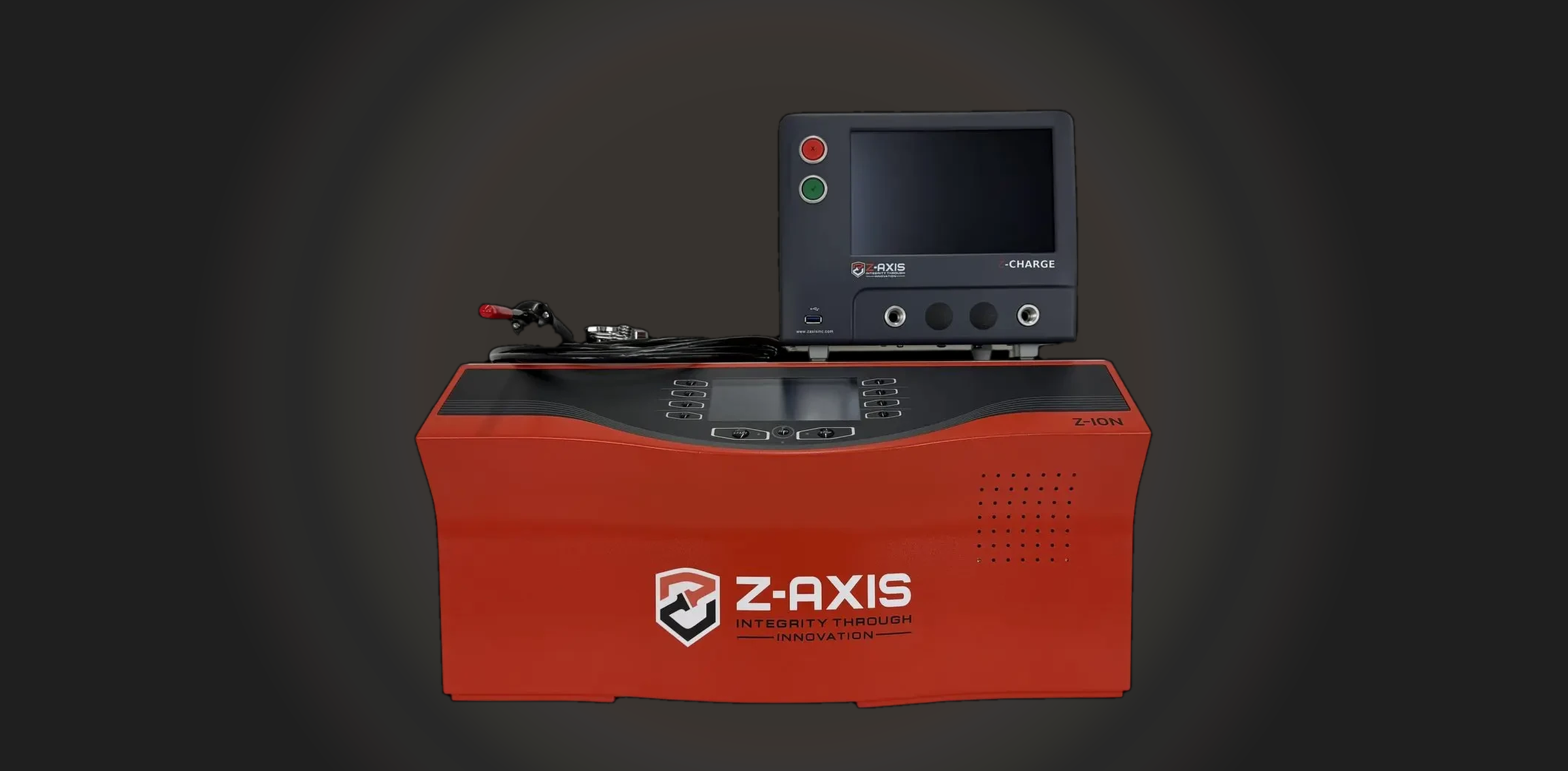
Match the detector approach to the part, access and result you need.
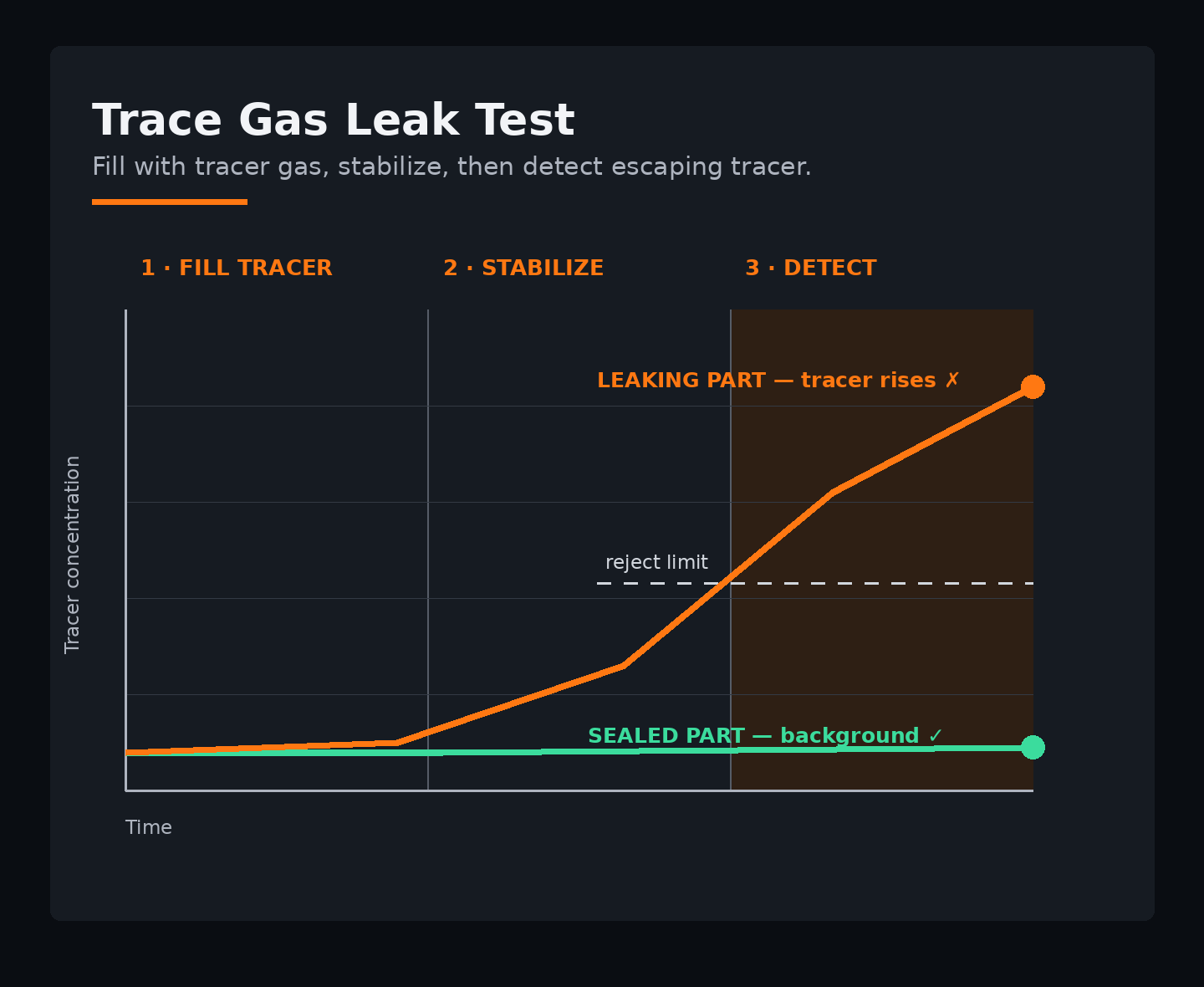 Trace GasDetect an identifiable gas escaping from a charged part for a sensitive quantitative result.
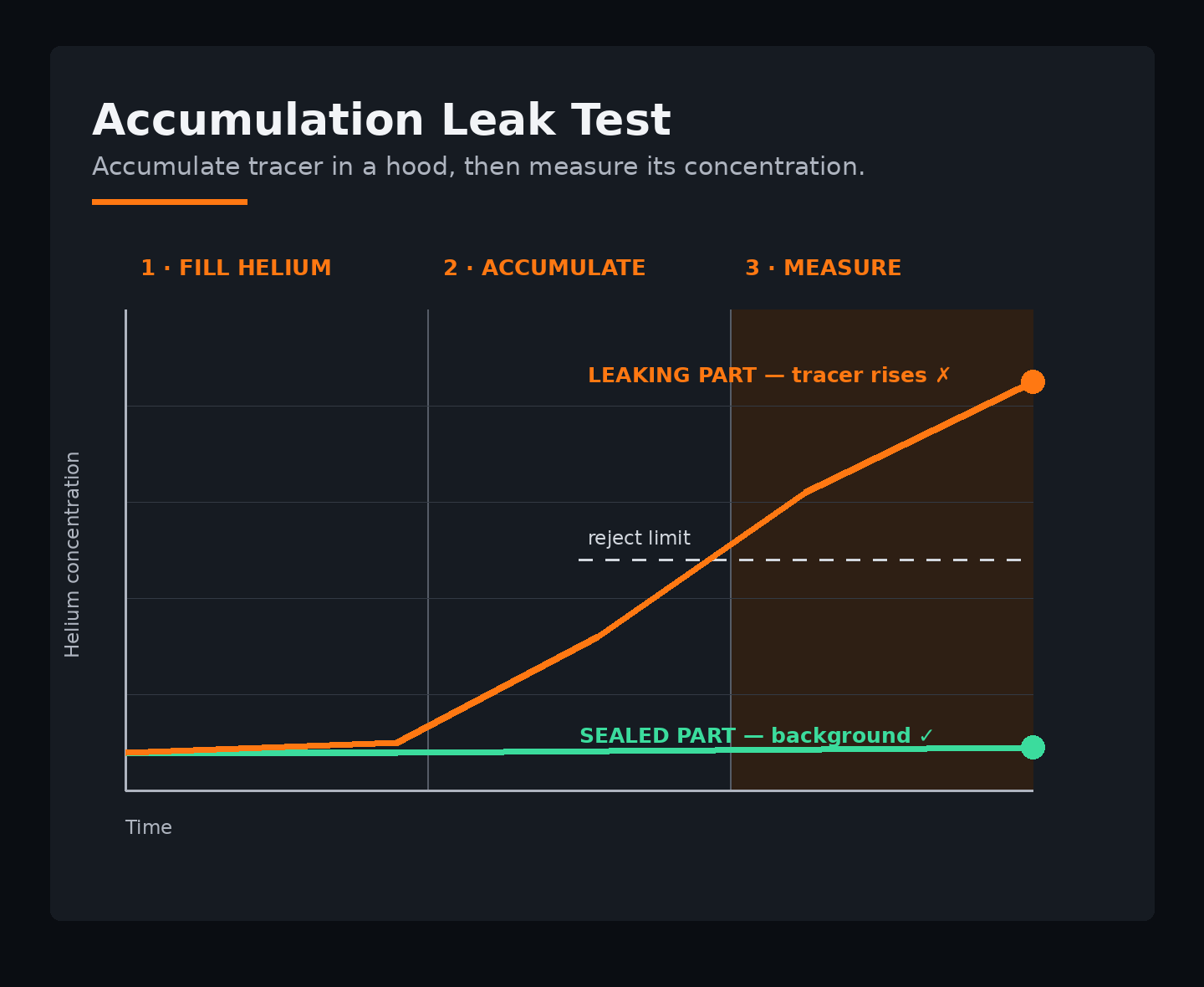 AccumulationCollect escaping gas around a large part at ambient pressure and measure the concentration trend.
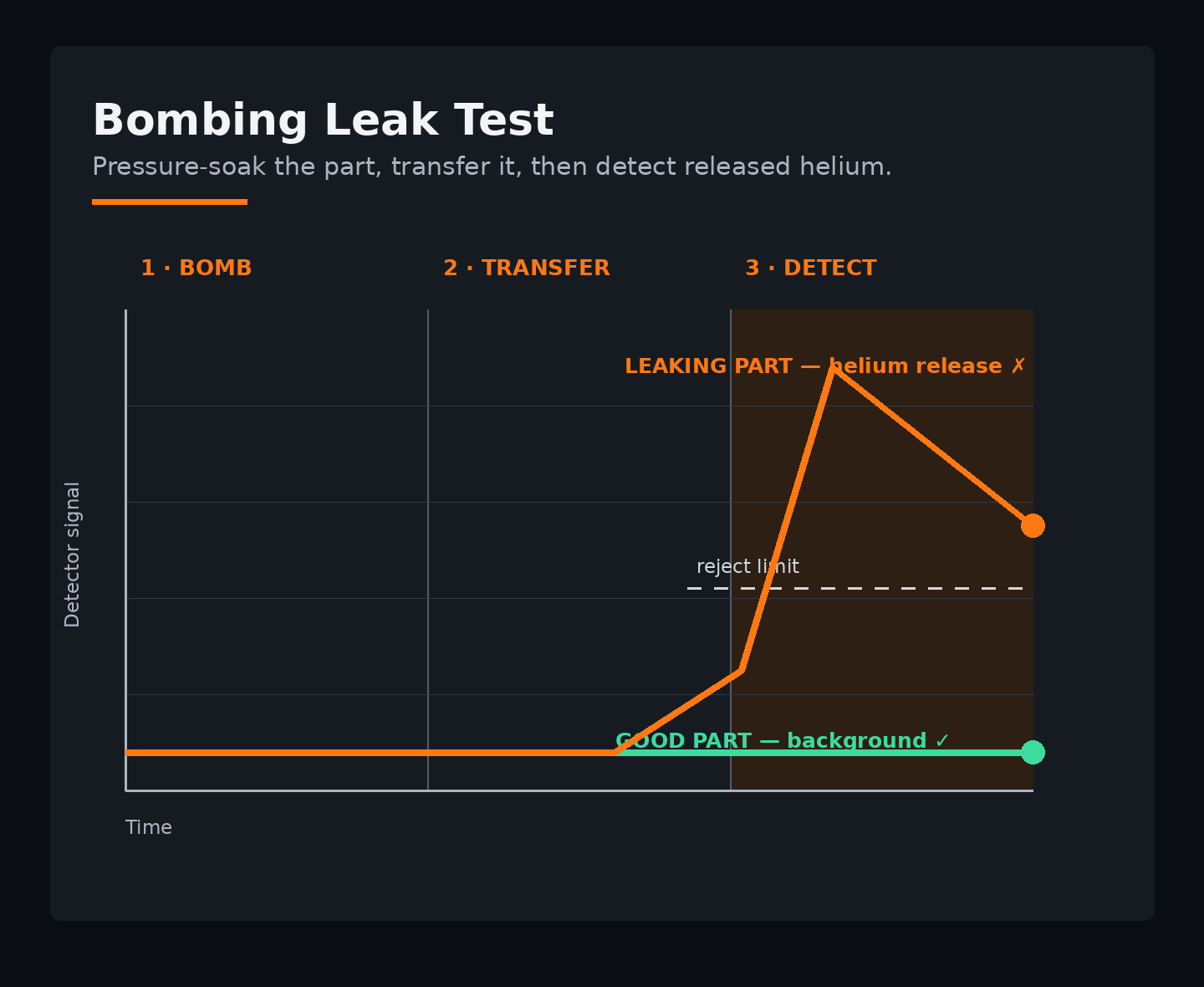 BombingVerify finished hermetic devices without a fill port through a helium soak and vacuum measurement.
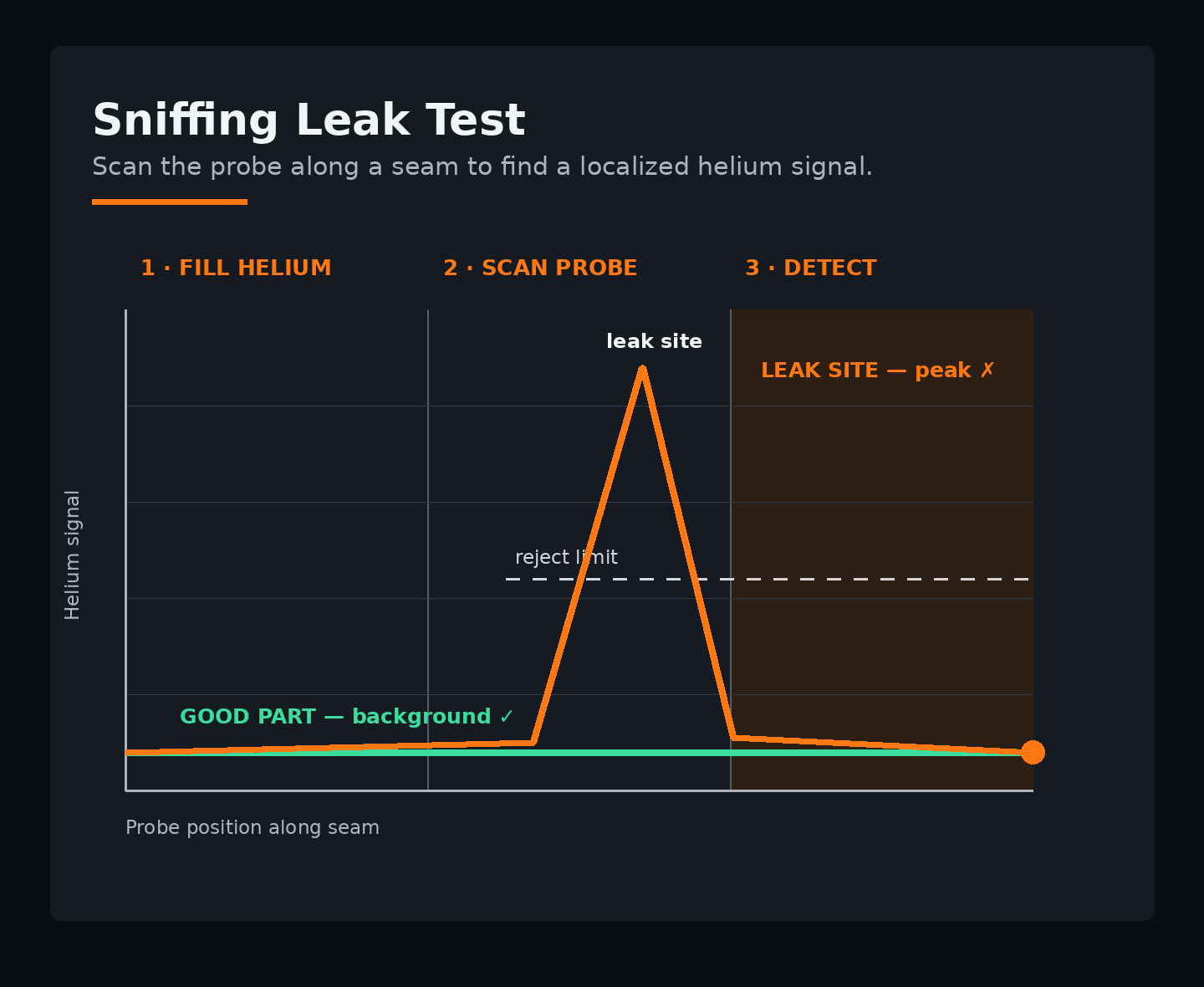 SniffingScan seams, joints and fittings with a probe to pinpoint the area where trace gas escapes.
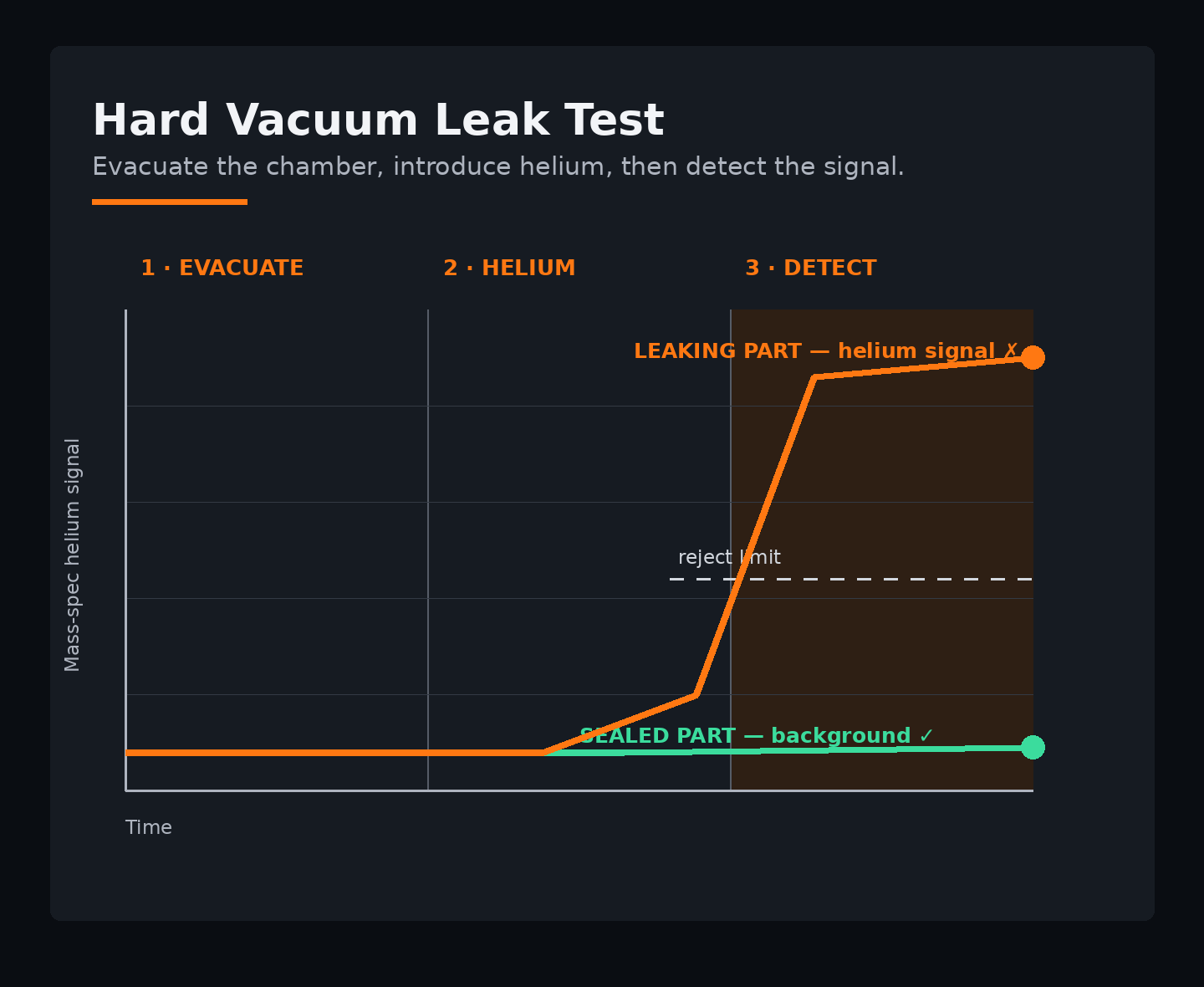 Hard VacuumMeasure total leakage from a helium-charged part in an evacuated chamber at maximum sensitivity.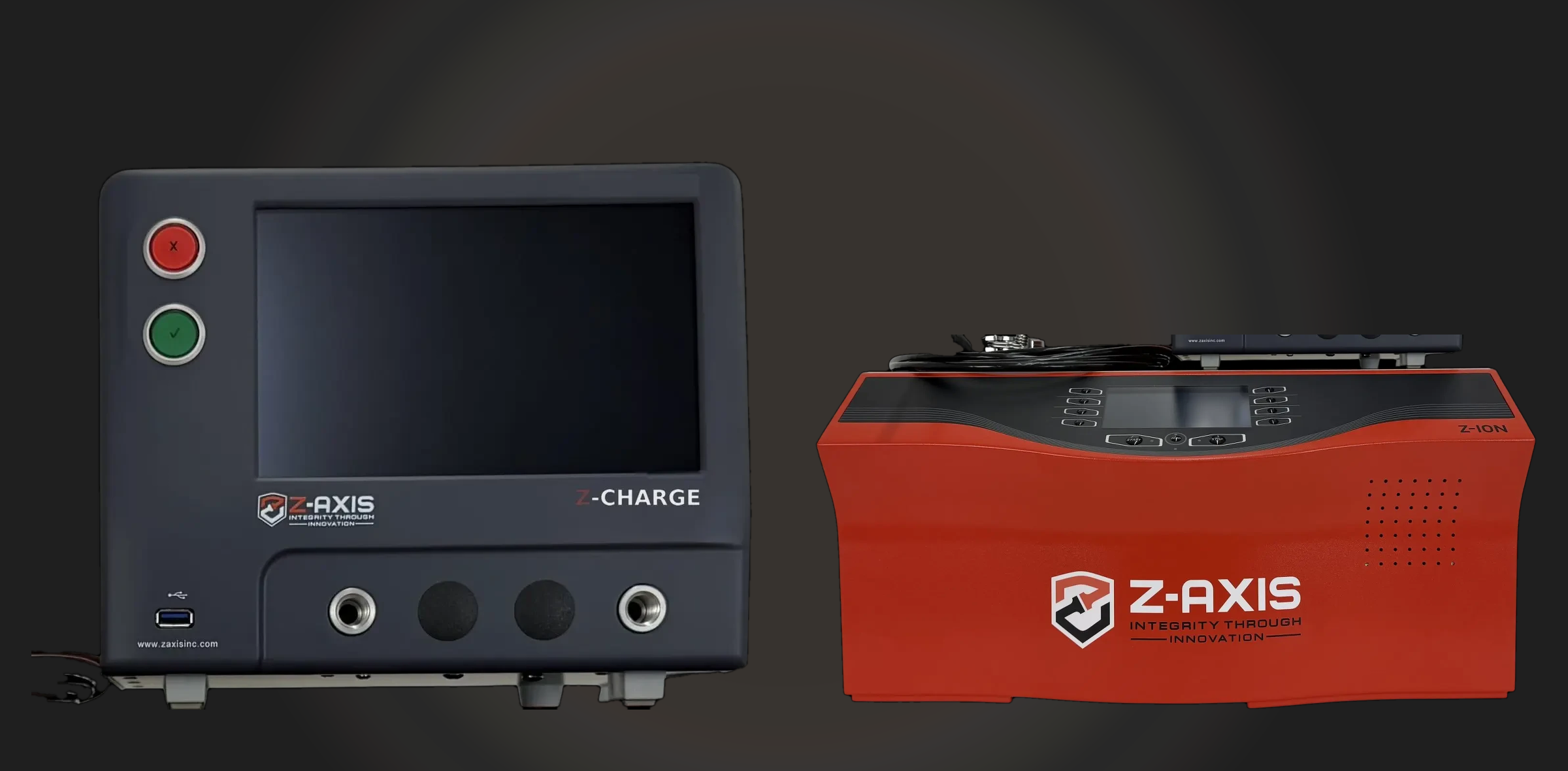
Z-Charge is the preparation and air-test controller. It evacuates, purges and charges the connected part, then coordinates the selected test sequence from a stored recipe.
Z-Ion is the helium mass-spectrometer detector. Working as one test cell, the pair combines preparation, air-based screening, trace-gas detection and results recording without handing critical timing back to the operator.
Explore Z-Charge & Z-IonInert, non-toxic and non-flammable, helium has low atmospheric background and supports the most sensitive hard-vacuum measurements.
Explore trace gas testing →A 5% hydrogen and 95% nitrogen mixture provides an economical option for high-throughput sniff detection.
Explore trace gas testing →Argon offers an alternative tracer, while compatible instruments can use clean, dry compressed air where the required sensitivity permits.
Explore trace gas testing →For air-based tester options, see Zaxis air leak testers.
| Method | Non-destructive | Needs an access port | Locates the leak | Typical use |
|---|---|---|---|---|
| Pressure decay | ✓ | ✓ | × | Sealed parts with a port |
| Vacuum decay | ✓ | ✓ | × | Parts and packaging |
| Mass flow | ✓ | ✓ | × | Flow-rate limits |
| Occlusion | ✓ | ✓ | × | Blocked passages |
| Burst | × | ✓ | × | Failure pressure |
| Pressure cracking | ✓ | ✓ | × | Valve opening pressure |
| Chamber | ✓ | × | × | Sealed parts, no port |
| Sniffing | ✓ | ✓ | ✓ | Finding the leak site |
| Hard vacuum | ✓ | ✓ | × | Hermetic, safety-critical parts |
| Accumulation | ✓ | ✓ | × | Large parts, total leak rate |
| Bombing | ✓ | × | × | Sealed parts, no fill port |
| Differential pressure | ✓ | ✓ | × | Large volumes, low leak rates |
| Trace gas | ✓ | ✓ | ✓ | Very small leaks, quantified |
It fills a sealed part with an identifiable gas and detects that gas after it escapes, rather than inferring leakage from a pressure change.
Use helium when the required sensitivity exceeds an air method, the result must be quantitative, or the leak location must be found.
Yes. Sniffing uses a probe to scan seams, joints, seals and fittings for escaping trace gas.
Hard vacuum measures total leakage from a helium-charged part in an evacuated chamber, while accumulation measures gas collected around a part.
A finished hermetic device receives a pressurized helium soak, then a vacuum measurement detects helium that leaves through a fine leak path.
Trace-gas methods may use helium, hydrogen forming gas, argon, or clean dry air with compatible detection.





