

Leak Testing & Dispensing Information & Best Practices
Leak Testing
What is a leak test?
A leak test is used to determine if an object, product, or system functions within a specified leak limit. Leaks occur when gas or liquid flow through an object via an imperfection or manufacturing defect such as holes, cracks, weak seals, etc. Leaks always flow from higher pressure to lower pressure; leak testers use pressure to generate and monitor that flow.
Leak Rate Calculator
A Leak rate is expressed as a volume per unit time. The rate is found by measuring the change in pressure multiplied by the volume and dividing that by the change in time multiplied by surrounding atmospheric pressure.
Leak Test Types
Leak detection is critical in any manufacturing process. Both destructive and non-destructive standard air leak tests are available to meet your specifications and satisfy any regulations for manufacturing lines and OEMs.

Ideal Gas Law
During leak testing, changes in pressure in the test part are of primary interest. When a test part is filled with air (or any other gas), it initially expands inside the part to occupy its volume. When the part finally reaches the test pressure, the air inside contracts. This rapid expansion and contraction of air changes its temperature and volume. The test part also undergoes slight changes in temperature and volume because of changes in temperature and volume of the air.
Water to Air Correlation
During leak testing, changes in pressure in the test part are of primary interest. When a test part is filled with air (or any other gas), it initially expands inside the part to occupy its volume. When the part finally reaches the test pressure, the air inside contracts. This rapid expansion and contraction of air changes its temperature and volume. The test part also undergoes slight changes in temperature and volume because of changes in temperature and volume of the air.
Testing Sealed Components
To leak test a sealed component, a chamber test is used. Place the part in a custom build nest and seal the chamber closed. Fill the chamber with a metered volume to a desired pressure. Then proceed with a standard pressure decay test. Any drop in pressure beyond a designated limit signifies a leak into the sealed part under test.
Leak Rate Calculator
Volume : cm3
Pressure: PSI
Time: seconds
Atmospheric pressure: PSI
Leak Rate: SCCM
Channel Sequencers
Concurrent and sequential test sequencers are available in the Isaac HD and 7i.
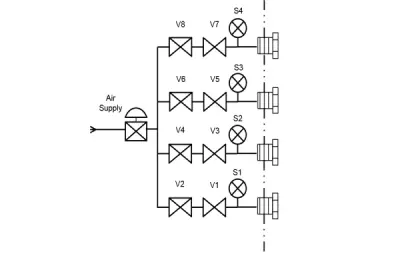
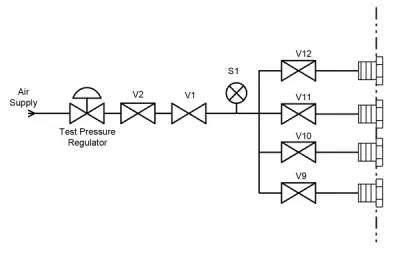
Concurrent testers run a single test on multiple channel outputs. Each channel has an independent set of test pneumatics and pressure sensors. Mass Flow, Pressure Decay, and Vacuum Decay can be used on concurrent models.
Sequential testers have a single sensor that is routed to test through one of four channel outputs, testing only one output at a time. The channels that are idle during test are naturally vented to atmosphere, allowing for cross-wall or inter-lumen inspection. All test types except Crack can be ran sequentially.
Metered Dispensing
Metering Pump Technology
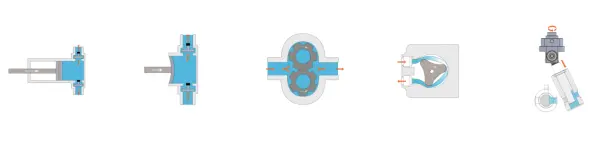
Delivery of a fluid in precise and adjustable flow rates is called metering. A metering pump is a device used to control the flow rate of a fluid. It is used to move a precise volume of liquid in a specified amount of time to provide an accurate volumetric flow rate. Typically, water, chemicals, solutions, and other fluids are moved by a metering pump. The flow rate depends on the outlet pressure, and is usually constant over time. These pumps have been designed to deliver a maximum discharge pressure so the selection of a suitable pump depends on the type of application. A vast majority of metering pumps can be categorized as positive displacement pumps.
Cavitation & Water Hammering
While handling pumping systems, it is critical to have a background understanding of some of the important concepts that govern pump performance, efficiency, output, and longevity. The following resource aims to discuss the concepts of Newtonian/Non-Newtonian fluids, water hammering, cavitation in pumps, and how these factors impact modern pumping systems.


