
Define
State the product condition to protect and the documented acceptance requirement.

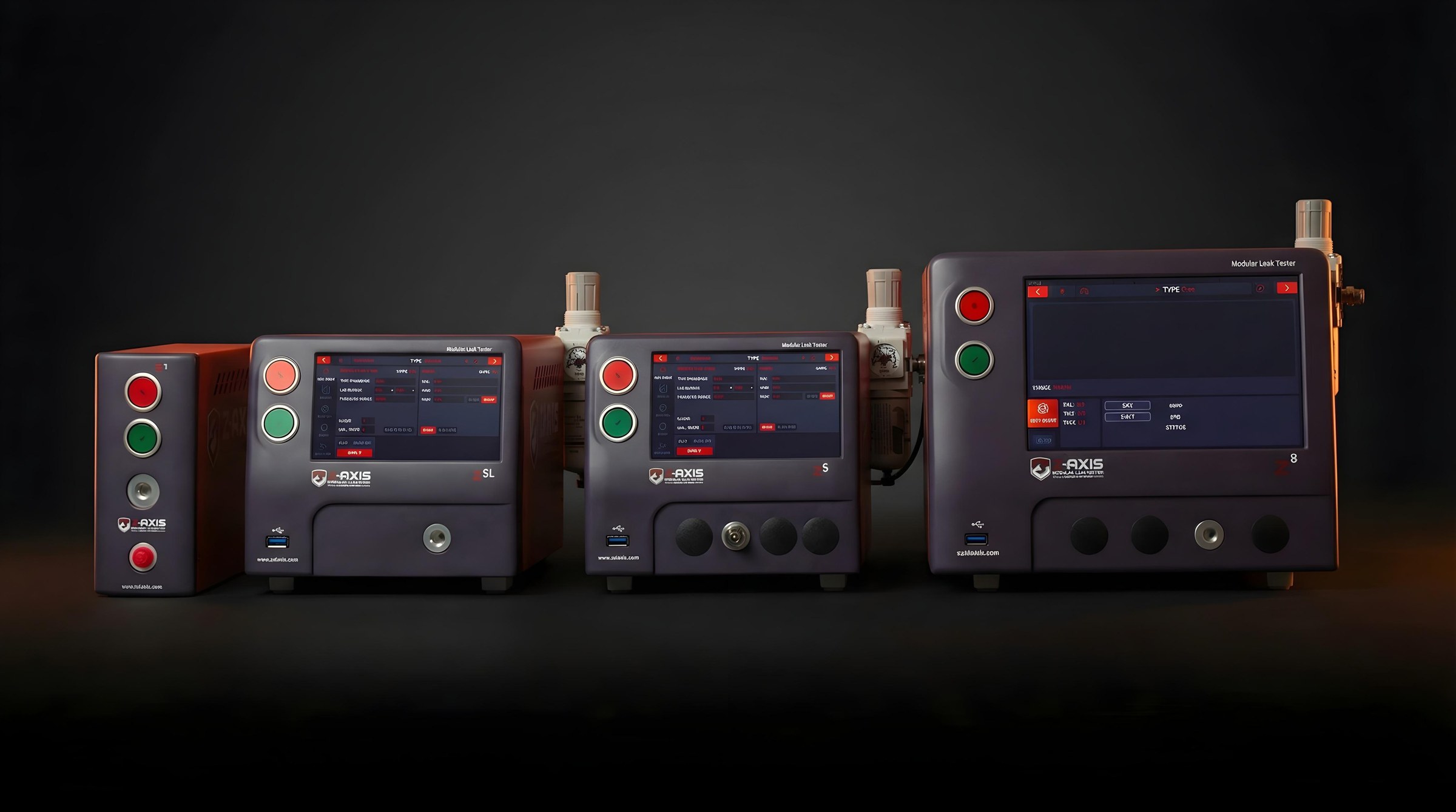
Leak Testing Guide
Choose a leak-test method by matching the part, leak requirement, access, cycle time and evidence needed—not by sensitivity alone.
Air leak testing and trace gas leak testing are peer families under leak testing. Each can be the better fit depending on the required result and production process.
Request a Quote Request a DemoThe table is a selection starting point, not a substitute for application validation. “Relative sensitivity” is deliberately qualitative because the actual result depends on the part, gas, volume, fixture, test program and acceptance limit.
| Method | What it measures | Typical part / volume fit | Relative sensitivity | Cycle-time fit | Destructive? | When to choose | Zaxis product |
|---|---|---|---|---|---|---|---|
| Pressure decay | Pressure drop over time | Sealed, accessible parts | Moderate | Production-cycle dependent | No | Air-based pass/fail on a sealed part | Z5, Z8 |
| Differential pressure decay | Difference from reference | Comparable sealed volumes | Moderate | Production-cycle dependent | No | Reference comparison helps the application | Z5 |
| Vacuum decay | Pressure rise under vacuum | Packages and suited sealed parts | Moderate to high | Production-cycle dependent | No | Vacuum test condition fits the part | Z8 |
| Mass flow | Air flow through a part | Flow paths and larger volumes | Moderate | Often suited to flow tests | No | Flow is the direct requirement | Ask Zaxis about the station configuration |
| Chamber / volumetric | Change around an enclosed part | No convenient internal port | Application dependent | Fixture dependent | No | An external chamber is required | VM3 |
| Burst / crack | Pressure at opening or failure | Components evaluated to failure | Application dependent | Test dependent | Usually | Strength or opening behavior is the question | Ask Zaxis about the application |
| Occlusion | Restriction or blockage | Tubes and flow paths | Application dependent | Production-cycle dependent | No | Blockage is the requirement | Ask Zaxis about the application |
| Trace gas: helium/hydrogen sniff or accumulation | Escaping identifiable gas | Small-leak or location needs | High to very high | Method dependent | No | Quantitative detection or location is required | Z-Charge + Z-Ion |
| Bubble / dunk | Visible bubbles in liquid | Gross-leak visual checks | Lower / visual | Manual or process dependent | Usually no | Visual gross-leak screening fits the process | Discuss the application with Zaxis |
Pressure decay, differential pressure, vacuum decay and mass flow are air-based methods that infer or measure a pressure or flow condition. They can be efficient production choices when their result matches the documented requirement. Trace gas testing uses an identifiable gas and detector; it is appropriate when the needed sensitivity, quantitative result or leak-site location calls for that approach.
Neither family is automatically “better.” Start with the acceptance limit and test conditions, then consider part access, volume, fixture, takt time, gas handling, data requirements and the production environment. For a pressure-decay deep dive, use the pressure-decay buyer’s guide. For trace-gas details, use the trace gas method page and Z-Charge + Z-Ion product information.
Document the part’s internal volume and accessible ports, allowed test pressure or vacuum, target cycle time, reject limit and units, fixture and seal strategy, channel count, automation I/O, environment and traceability needs. A production test must be validated as a complete part-fixture-program system.
Start with the part’s leak requirement, access, volume, cycle-time target and whether you need a pass/fail result or leak location.
No. Air leak testing and trace gas leak testing are peer method families under leak testing; they use different measurement approaches.
No. Select the method that supports the documented reject limit and production requirements, then validate the complete station.
A chamber fixture can test the space around an enclosed part; feasibility depends on the part, fixture and acceptance requirement.
Bubble or dunk testing can provide visual evidence for some applications, but the right choice depends on the needed measurement and production process.
“What it measures” matters because methods do not all produce the same evidence. A pressure-decay program observes pressure change after isolation. A mass-flow setup observes air flow. A trace-gas detector measures escaping identifiable gas. A bubble test relies on visual observation. Select the evidence that maps to the product requirement and the production decision.
Part access matters too. A direct pressure or vacuum connection may be straightforward for a housing, tube or fluid path, but not for a finished enclosure with no suitable port. A chamber can make an external test possible, although chamber volume, seals and loading must be considered. A sniffing operation requires physical access to the areas where a leak may be located.
Cycle time is a station question. It includes loading, connection, fill or evacuation, stabilization, measurement, venting or recovery, unloading and any data exchange. A method should be evaluated with the intended fixture and part, not from a general timing assumption. The production team should also decide whether a failed part needs a simple reject, a repeat test, a diagnostic sequence or a leak-location step.
State the product condition to protect and the documented acceptance requirement.
Record the part volume, ports, surfaces, materials and fixture constraints.
Match direct pressure, vacuum, flow, chamber or trace-gas evidence to the requirement.
Evaluate representative parts and the complete station before production release.
Use the method pages as starting points: pressure decay, vacuum decay, mass flow, chamber testing, and trace gas testing. For a current station, preserve the existing test evidence and compare any new method against the actual product requirement rather than changing a limit by assumption.
Do not specify a method from a product name alone. Ask whether the part can be pressurized or evacuated, whether a leak must be located, whether the measured condition must be recorded, and whether the result must be obtained in a fixed production interval. Ask what the fixture itself contributes to the test volume and whether it can be checked independently.
Also identify what happens after a failure. A high-volume station may need a simple reject and traceable record; a development or diagnostic process may add a second method to find the leak site. This is why a production air-based test and a trace-gas diagnostic step can coexist without one being described as a subset of the other.
Once a method is selected, record the part revision, fixture, programmed stages, acceptance logic and handling of failed units. That record allows quality, manufacturing and maintenance teams to distinguish a product change from a station change and to review future updates against the original decision.
For test-system design, read the Leak Test Fixture Design Guide; for ingress-driven enclosure programs, read IP67 / IP68 Leak Testing in Production.
See the leak-testing glossary for definitions used in this comparison.


