
FILL
Connect the part with the appropriate fitting or fixture and apply negative pressure.

Leak Test Method
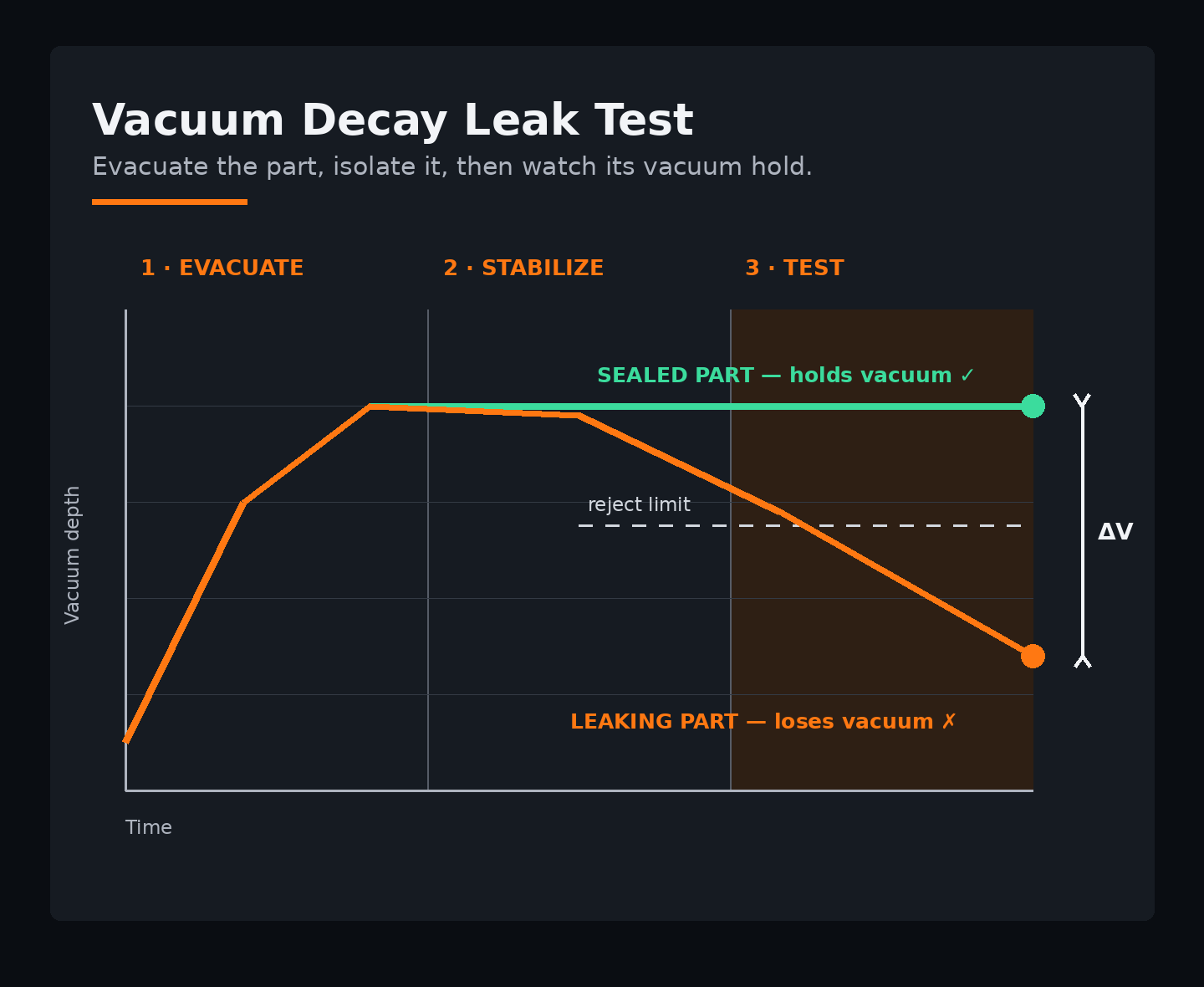
A vacuum decay leak test evacuates a sealed part, isolates the vacuum source, and measures pressure movement over time to make a pass/fail decision.
Vacuum decay is a non-destructive test for parts, packaging and industrial components. The part connects to the tester through a fitting or fixture, and the system applies negative pressure before measurement begins.
Once the selected negative pressure is reached, the sequence moves through settle and test stages. The pressure sensor watches for a rise toward atmospheric pressure, indicating that air is entering the test volume.
It replaces a traditional dunk test with a programmed sequence and a clear result. Common applications include medical catheters, fuel injectors, implantable devices, electronic enclosures, sensors, packaging, radios, cell phones and smartwatches.
Request for QuoteA vacuum decay test checks whether a sealed part can hold negative pressure. After the part is connected, the tester evacuates it to the selected vacuum level and closes the valves. If outside air enters through a leak, the pressure moves toward atmosphere during the test interval.
It follows the same production discipline as pressure decay, but applies vacuum instead of positive pressure. That makes it useful when the part, its package or the intended application calls for negative pressure.
The tester returns a pass or fail against the programmed specification. It does not identify a leak’s physical location; use sniffing testing when location is required.
Connect the part with the appropriate fitting or fixture and apply negative pressure.
After the fill timer ends, allow the part to accommodate stretching or flexing before measurement.
Measure any increase in vacuum pressure during the programmed test interval.
Vent the remaining negative pressure in the system to atmosphere.
A part that remains within its pre-set vacuum-decay specification passes; a part that falls below its lower limit fails.
Zaxis vacuum decay testing produces results with resolution up to the fifth decimal place, or 0.00001 PSI. That resolution supports fast, repeatable test cycles.
Fill, settle, test and vent are programmed stages. The settle stage gives a part that stretches or flexes under vacuum time to stabilize before measurement begins.
The fitting or fixture connects the test volume to the part. A stable connection and a consistent programmed sequence support repeatable pass/fail decisions on the production line.
After the vacuum source is isolated, the tester measures pressure change over the selected interval. A part within the programmed limit passes; one that exceeds it is rejected without being damaged or opened.
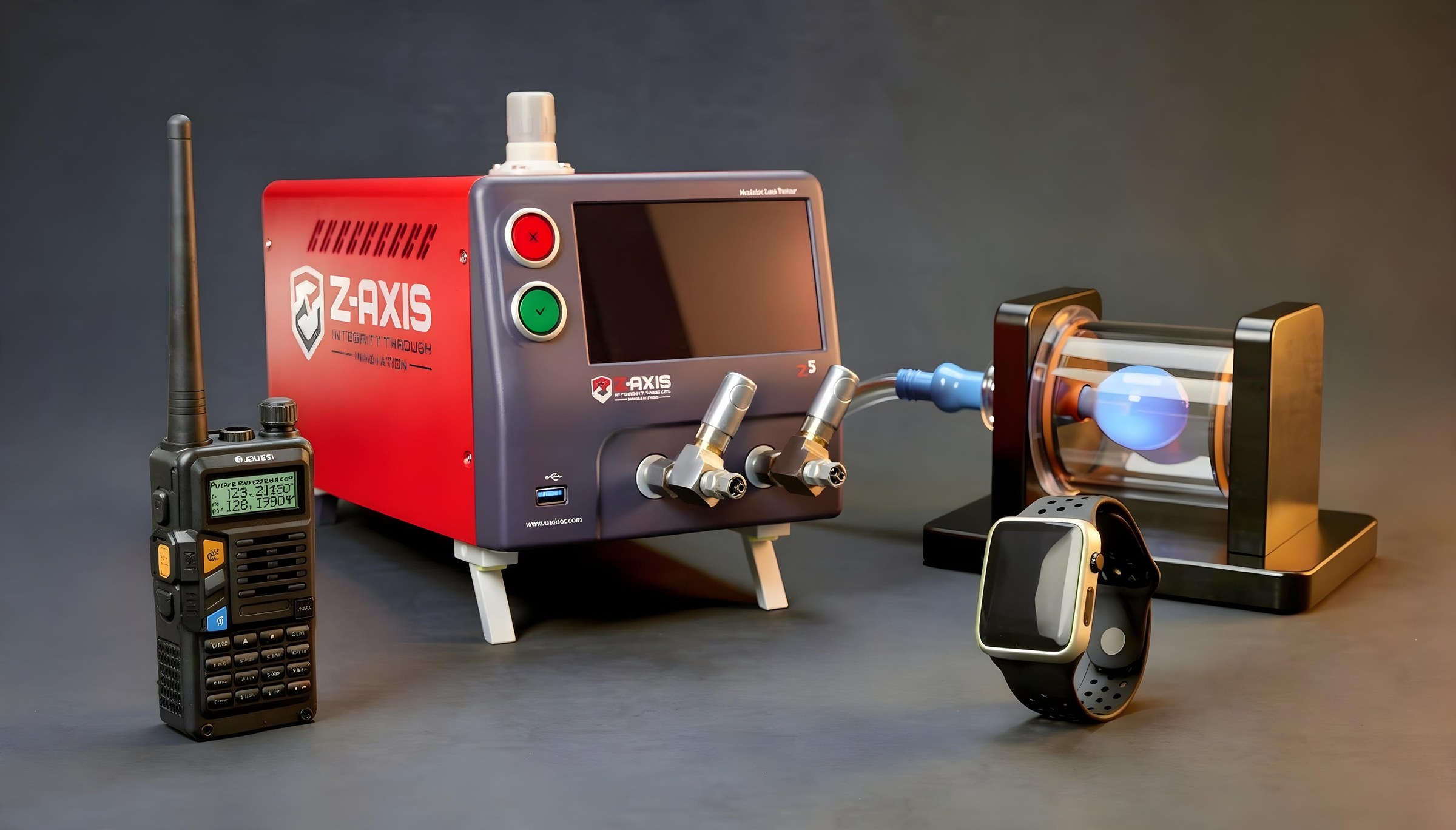
Every Zaxis air leak tester runs vacuum decay alongside pressure decay. They differ in channel count, interface and enclosure, so the choice comes down to where the tester has to live and how many parts it has to handle.
Vacuum decay is used to confirm that sealed medical components do not leak before they reach end users.
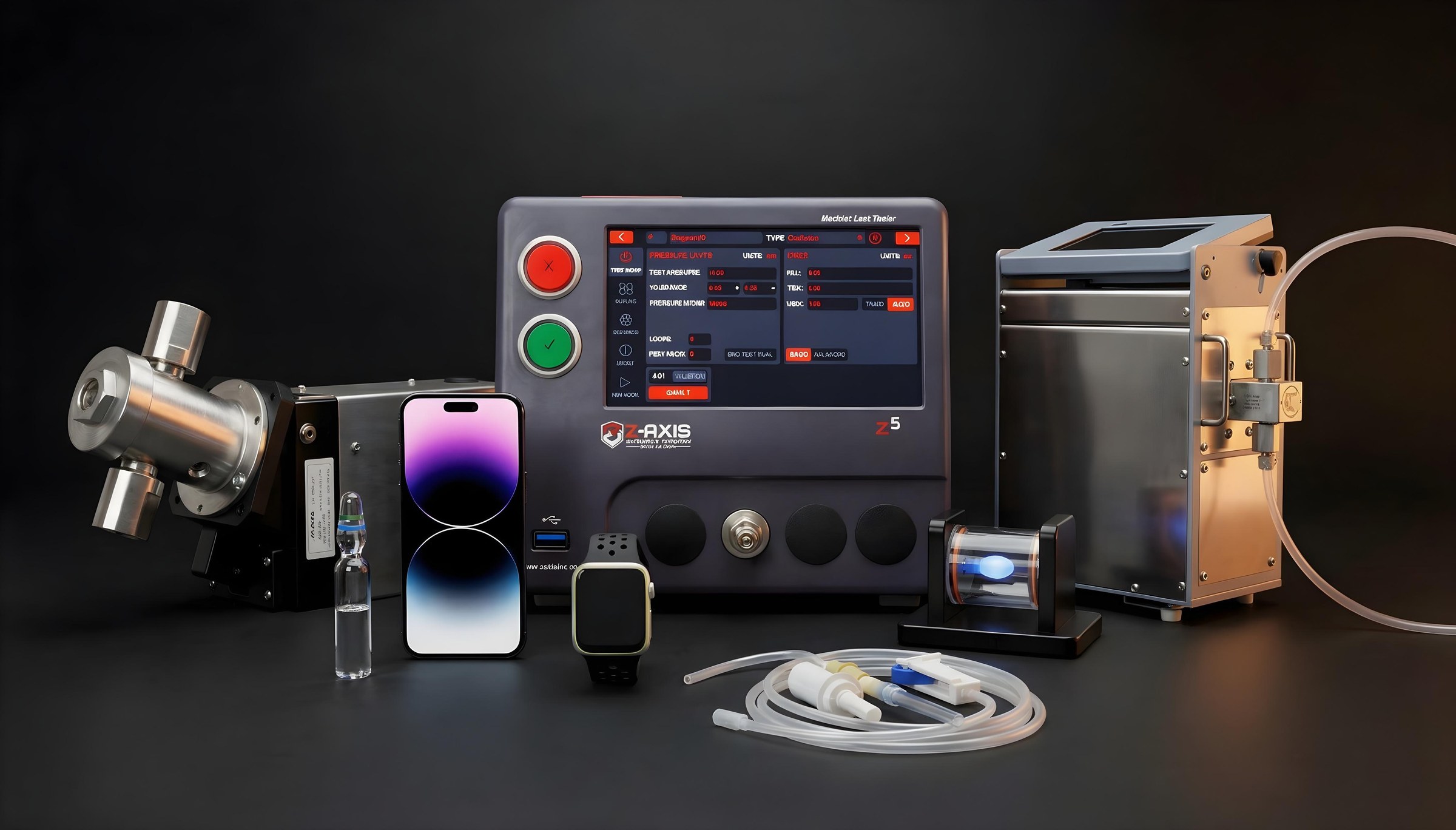
Sealed packages can be tested with a non-destructive vacuum sequence.
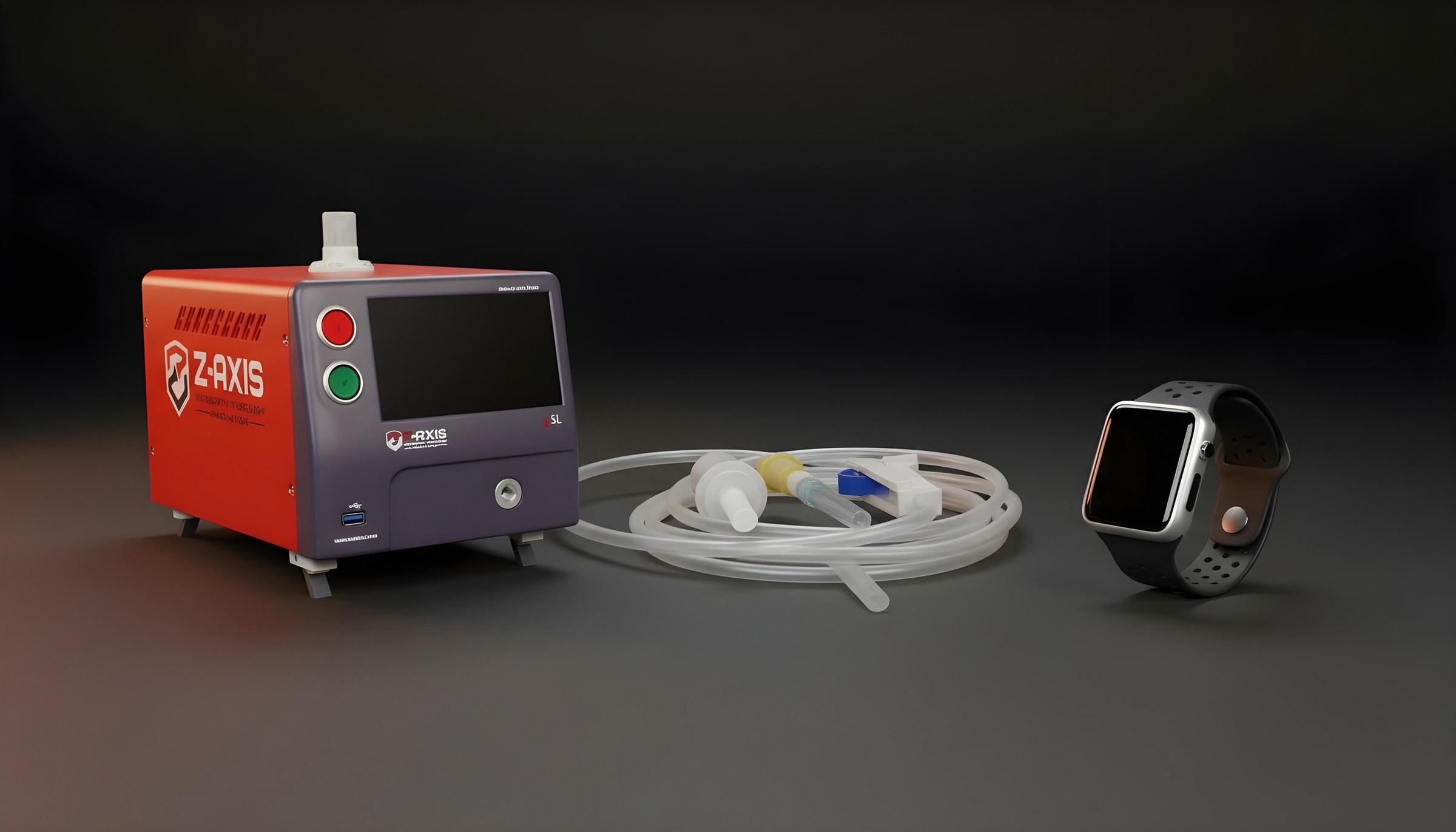
Enclosures, sensors, radios, cell phones and smartwatches are applications for vacuum decay testing.

Industrial components can be connected through a fitting or fixture for a repeatable vacuum test.
| Method | Non-destructive | Needs an access port | Locates the leak | Typical use |
|---|---|---|---|---|
| Pressure decay | ✓ | ✓ | × | Sealed parts with a port |
| Vacuum decay | ✓ | ✓ | × | Parts and packaging |
| Mass flow | ✓ | ✓ | × | Flow-rate limits |
| Occlusion | ✓ | ✓ | × | Blocked passages |
| Burst | × | ✓ | × | Failure pressure |
| Pressure cracking | ✓ | ✓ | × | Valve opening pressure |
| Chamber | ✓ | × | × | Sealed parts, no port |
| Sniffing | ✓ | ✓ | ✓ | Finding the leak site |
| Hard vacuum | ✓ | ✓ | × | Hermetic, safety-critical parts |
| Accumulation | ✓ | ✓ | × | Large parts, total leak rate |
| Bombing | ✓ | × | × | Sealed parts, no fill port |
| Differential pressure | ✓ | ✓ | × | Large volumes, low leak rates |
| Trace gas | ✓ | ✓ | ✓ | Very small leaks, quantified |
It applies negative pressure to a sealed part, isolates the vacuum source and measures pressure movement over a test interval.
No. It is a non-destructive method for parts, packages and industrial components.
Air entering the evacuated test volume causes pressure to rise toward atmosphere during the test.
Settle time allows part stretching or flexing to stabilize before the vacuum decay measurement begins.
Zaxis vacuum decay testing produces results with resolution up to the fifth decimal place, or 0.00001 PSI.
Applications include implantable devices, electronic enclosures, sensors, packaging, radios, cell phones and smartwatches.
No. It provides a pass/fail decision; use sniffing testing when the leak location is needed.

For sealed pharmaceutical and medical packages, see Pharmaceutical & Medical Packaging Leak Testing for chamber, vacuum-decay and validation context.
For package-method scope context, see the ASTM F2338 explainer.
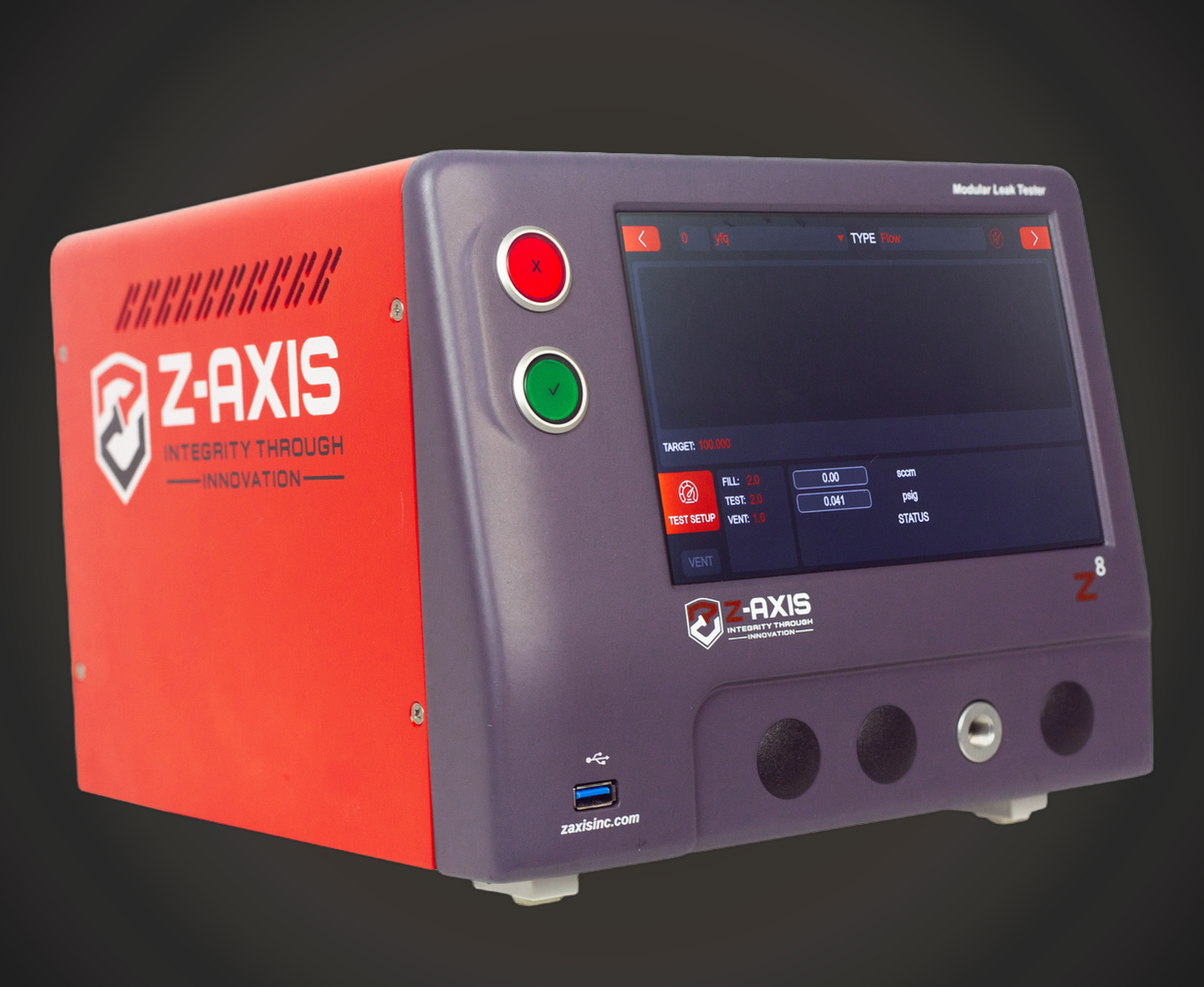
 Z8Up to four test ports, an 8-inch touchscreen, and vacuum capability for automated production lines.
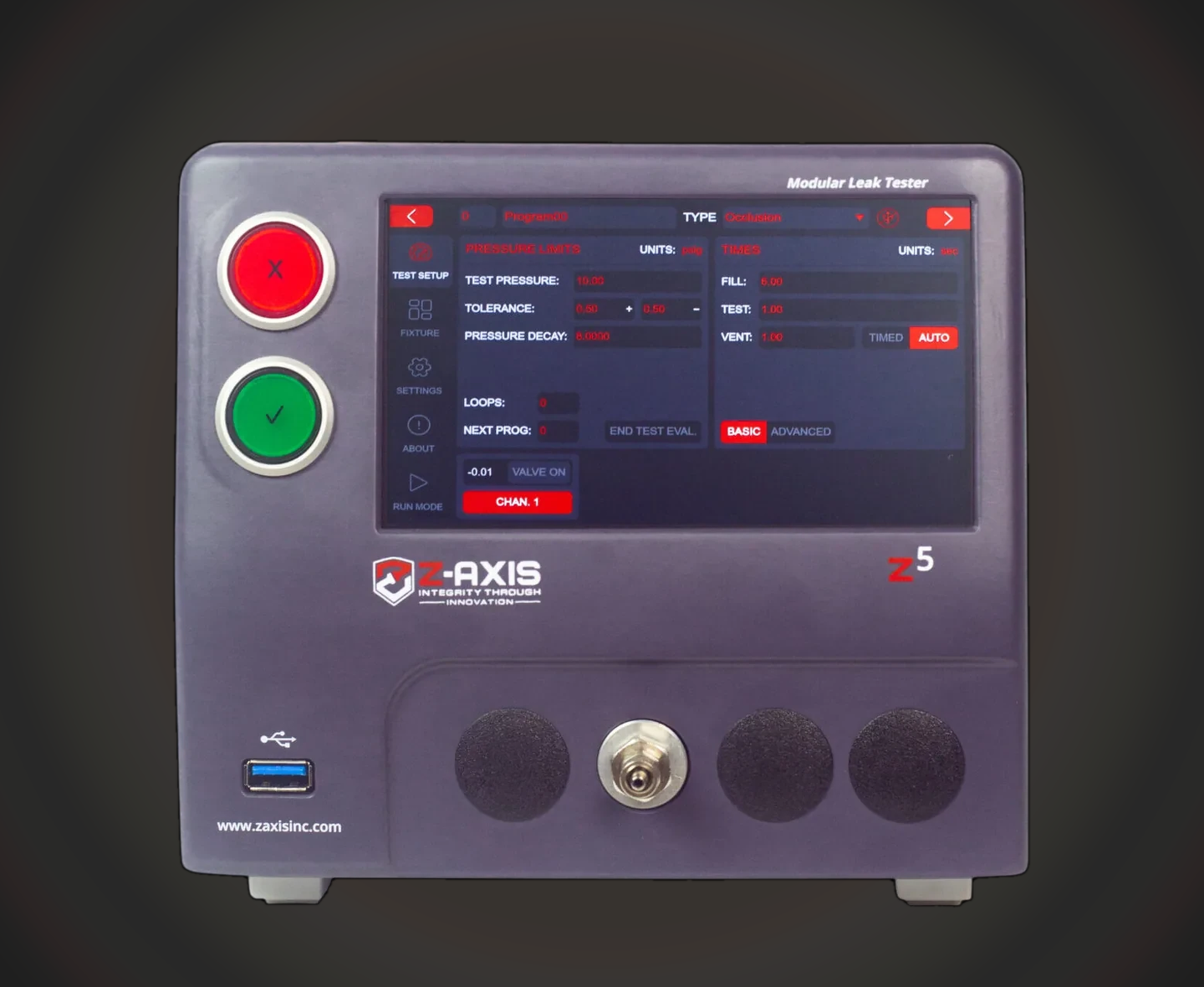 Z5A compact multi-channel tester with vacuum decay capability and a 6.5-inch-wide cabinet.
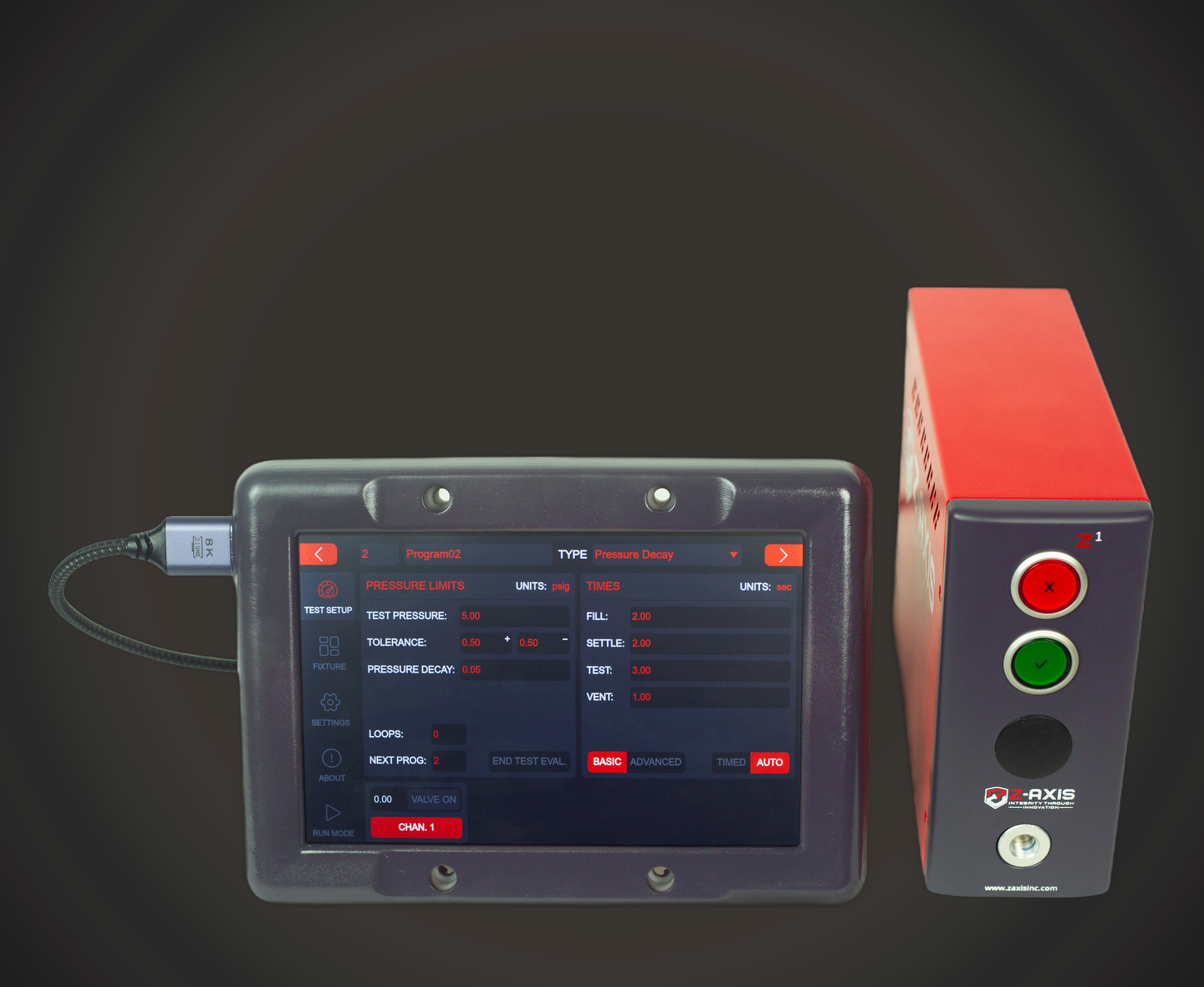 Z1A 2.6-inch-wide machine-integrated tester for pressure/vacuum decay applications.



