
Low-volume range
Route a microliter-scale requirement to the M-Series and validate at the actual fluid condition.
View M-Series
Precision Dispensing Applications
Diagnostic reagent dispensing is controlled transfer of reagent or buffer volumes into a laboratory or IVD workflow.
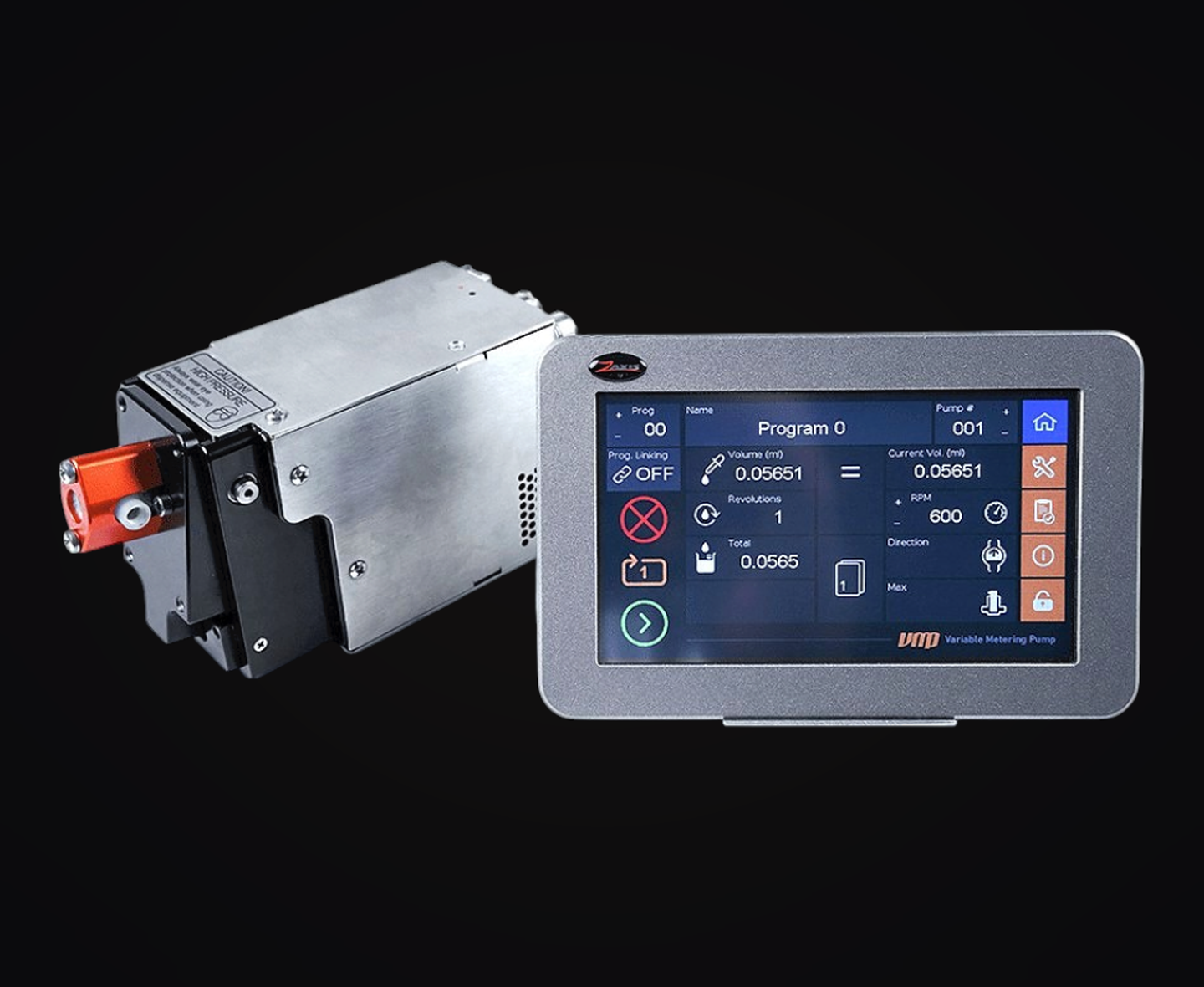
A pump selection should begin with the intended dose, fluid path and production controls—not a generic performance number. Zaxis eVmP configurations provide valveless positive-displacement metering with published M-Series, V-Series and electronic-drive options.
Request for Quote Request a DemoFor IVD and laboratory equipment, repeatable low-volume delivery is only one part of the station: the application also needs appropriate wetted materials, connections, containers, nozzles and controls.
Route a microliter-scale requirement to the M-Series and validate at the actual fluid condition.
View M-SeriesRoute larger stated dispense volumes to the V-Series.
View V-SeriesPlan configuration and commands with the eVmP family.
View eVmP familyA valveless ceramic-piston arrangement removes external supply and discharge check valves from the pump path. That can simplify the fluid path for an OEM system, but compatibility and cleaning remain application-specific decisions.
Use product datasheets to review wetted materials and available configurations before qualifying the complete dispensing station. The fluid, reagent stability, cleaning procedure and system connection determine the appropriate selection.
The M-Series is the published microliter option, with 2.5–100 µL per revolution. The V-Series has a published 25 µL–1.28 mL per revolution range. These ranges guide a conversation; they do not replace testing at the actual fluid and nozzle.
Electronic adjustment can help a machine builder store or change dispensing settings. Specify the required recipe handling, trigger method and process evidence with the equipment team.
Document the required pump head, drive, enclosure, fluid connections and controls early. Published eVmP materials list digital I/O and RS485, with optional EtherNet/IP on applicable configurations; confirm availability on the selected configuration.
A dispensing system should be evaluated as a whole. The pump may meter fluid, while the nozzle, container, motion and validation approach determine what the final station accomplishes.
Use the metering pump comparison to begin a range and configuration discussion.
A valveless ceramic-piston path has no external supply or discharge check valves; evaluate its fit with the actual reagent and system.
The published M-Series range is 2.5–100 µL per revolution.
Review the selected datasheet, wetted materials and the actual chemical before qualification.
eVmP configurations are intended for system integration; define the required drive, enclosure and interface with Zaxis.
No. Validate the complete pump, fluid, nozzle, container and production station for the intended process.
Share the fluid, volume, flow, wetted-path and automation requirements with Zaxis.
Request for Quote
