
BOMB
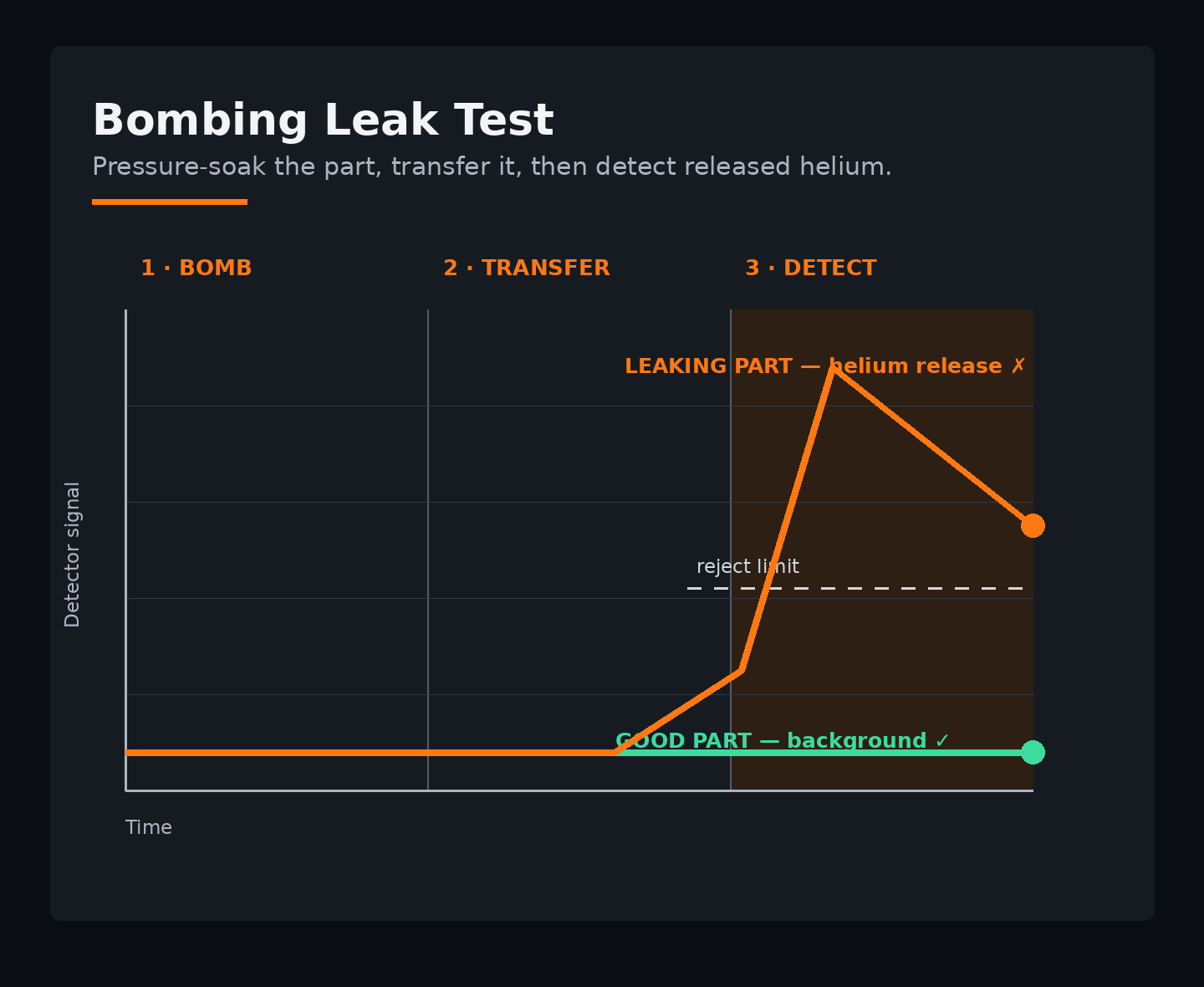
Place finished hermetic parts in a pressure vessel filled with helium at elevated pressure for a timed soak.

Helium Leak Test Method
Bombing leak testing exposes fine leaks in finished hermetic parts by driving helium into a sealed device, then measuring helium that escapes under vacuum.
Bombing, also called helium bomb testing, is a trace-gas method for finished hermetically sealed parts with no fill port. It can test sealed implantable devices, MEMS, relays and crystals after assembly is complete.
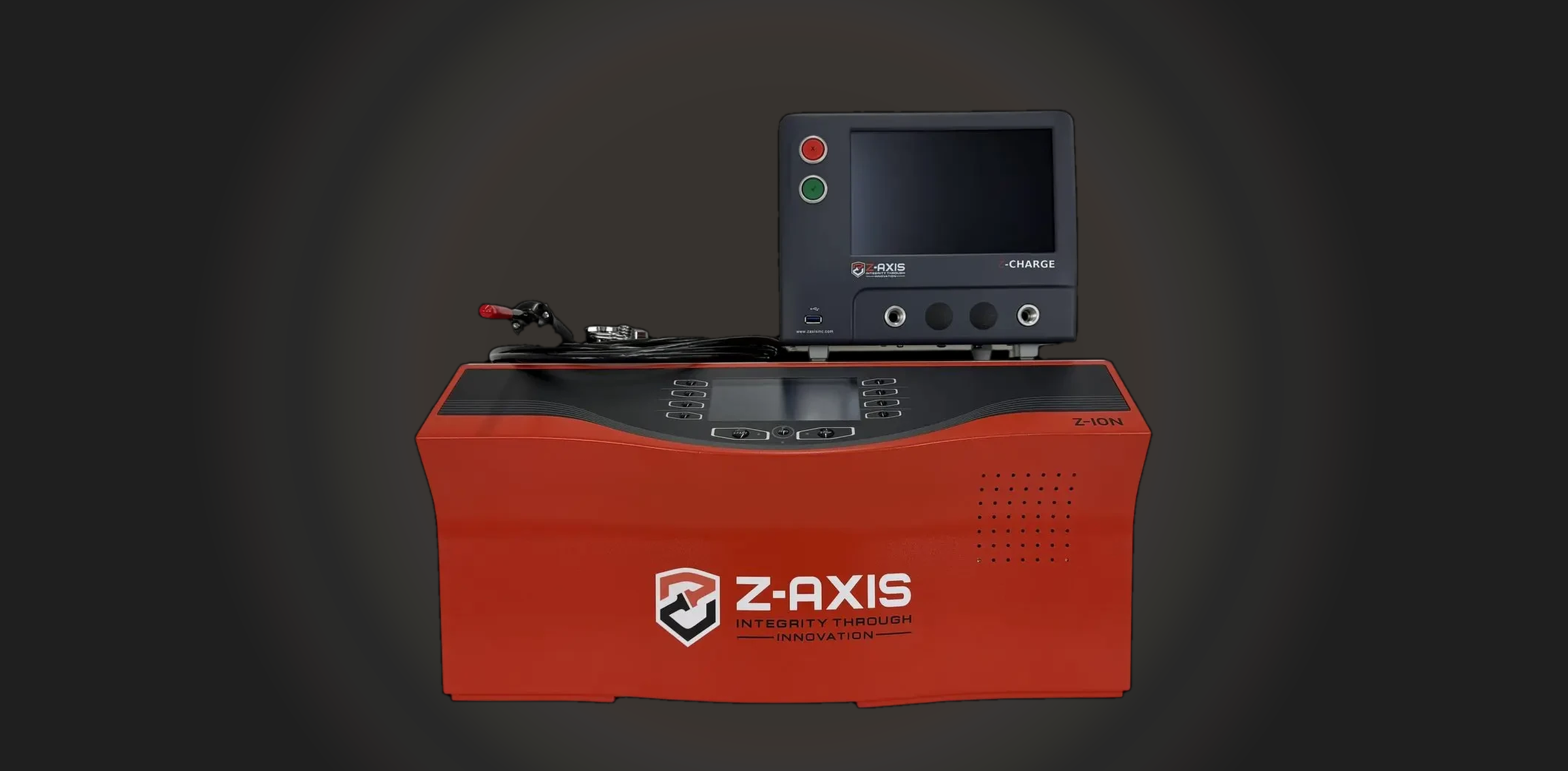
Parts soak in helium at elevated pressure inside a pressure vessel. If a leak path is present, helium enters the part; the part then moves to a vacuum chamber, where a helium mass spectrometer measures the gas as it bleeds back out.
That measurement reveals and quantifies leakage. Bombing reaches fine-leak sensitivity in the 10⁻⁹–10⁻¹⁰ mbar·l/s range.
Request for QuoteBombing tests a finished sealed device without opening it or using a fill port. Helium is introduced through any existing leak path rather than a service connection.
The device receives a timed elevated-pressure helium soak in a pressure vessel. A leaking device retains helium, which can then be measured after transfer to a vacuum chamber.
The mass spectrometer measures helium released from the evacuated device and compares the signal with its reject limit. The result is a quantitative fine-leak decision in the 10⁻⁹–10⁻¹⁰ mbar·l/s range.
The station is configured for the part and its reject limit, then runs the soak, transfer and detector measurement as one recorded production sequence.
The pressure vessel begins the measurement. Elevated-pressure helium reaches any path between the sealed interior and the vessel, and the timed soak gives it a controlled opportunity to enter a leaking device. Because the gas travels through a leak path rather than a service connection, the part remains sealed throughout the test.
The vacuum measurement completes the cycle. In the evacuated chamber, helium retained by a leaking part can leave into the chamber and be measured by the mass spectrometer. Comparing that signal with the programmed reject limit gives a quantitative decision for the part.
Bombing covers fine leakage; a paired gross-leak check catches defects that release helium too quickly for the post-bomb measurement. Together they address both very small and very large leak paths in a finished hermetic device.
Place finished hermetic parts in a pressure vessel filled with helium at elevated pressure for a timed soak.
Move parts from the bomb to the vacuum measurement chamber after the soak.
A mass spectrometer measures helium bleeding back out of a leaking part.
Compare the measured signal with the programmed reject limit and record the result.
A part within its programmed reject limit passes; a signal above the limit fails.
Bombing detects helium that entered a part during the pressure soak and escapes after the part reaches vacuum. The measurement is a total leak result rather than a leak-location result.
Gross leaks need their own screen: a large path can fill and empty fast enough for helium to escape before the vacuum measurement. Pairing bombing with a gross-leak test covers that behavior.
Soak time, transfer time and measurement time are controlled together. A repeatable cell coordinates the pressure vessel, vacuum measurement and gross-leak screen so every part follows the same cycle.
Pressure, soak duration and transfer time are controlled so helium exposure is comparable from part to part.
The mass spectrometer measures helium released in the evacuated chamber and compares the signal with the programmed reject limit.
Together, the fine-leak and gross-leak checks address the distinct behavior of small and large leak paths.
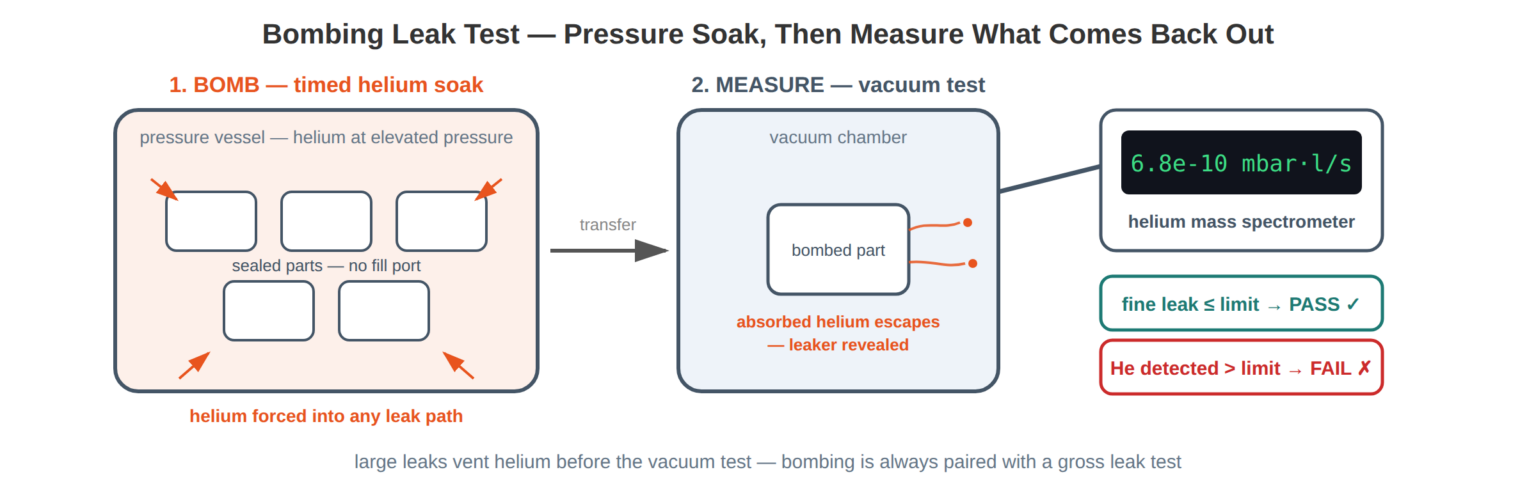
Bombing is a helium method: the part is soaked in a pressure vessel, then measured under vacuum. Z-Charge handles the helium charge and Z-Ion the detection.

Finished implantable devices can be evaluated for fine-leak integrity after they are hermetically sealed.
Sealed MEMS, relays and crystals can be tested without a direct fill connection.
Finished hermetic electronic packages can be checked after sealing.
| Method | Non-destructive | Needs an access port | Locates the leak | Typical use |
|---|---|---|---|---|
| Pressure decay | ✓ | ✓ | × | Sealed parts with a port |
| Vacuum decay | ✓ | ✓ | × | Parts and packaging |
| Mass flow | ✓ | ✓ | × | Flow-rate limits |
| Occlusion | ✓ | ✓ | × | Blocked passages |
| Burst | × | ✓ | × | Failure pressure |
| Pressure cracking | ✓ | ✓ | × | Valve opening pressure |
| Chamber | ✓ | × | × | Sealed parts, no port |
| Sniffing | ✓ | ✓ | ✓ | Finding the leak site |
| Hard vacuum | ✓ | ✓ | × | Hermetic, safety-critical parts |
| Accumulation | ✓ | ✓ | × | Large parts, total leak rate |
| Bombing | ✓ | × | × | Sealed parts, no fill port |
| Differential pressure | ✓ | ✓ | × | Large volumes, low leak rates |
| Trace gas | ✓ | ✓ | ✓ | Very small leaks, quantified |
It is a helium trace-gas method for finished hermetic parts with no fill port. Parts soak in helium under pressure, then a mass spectrometer measures helium released under vacuum.
Finished implantable devices, MEMS, relays and crystals are examples of parts suited to bombing.
No. It measures helium leaving the part to reveal and quantify total leakage; sniffing is used when the leak site must be located.
Bombing provides fine-leak sensitivity in the 10⁻⁹–10⁻¹⁰ mbar·l/s range.
A large leak can fill and empty quickly, allowing helium to escape before the vacuum measurement. A gross-leak screen provides the paired coverage.
No. It is intended for finished hermetically sealed parts with no fill port.
The part is transferred to a vacuum chamber, where a mass spectrometer measures helium bleeding back out.

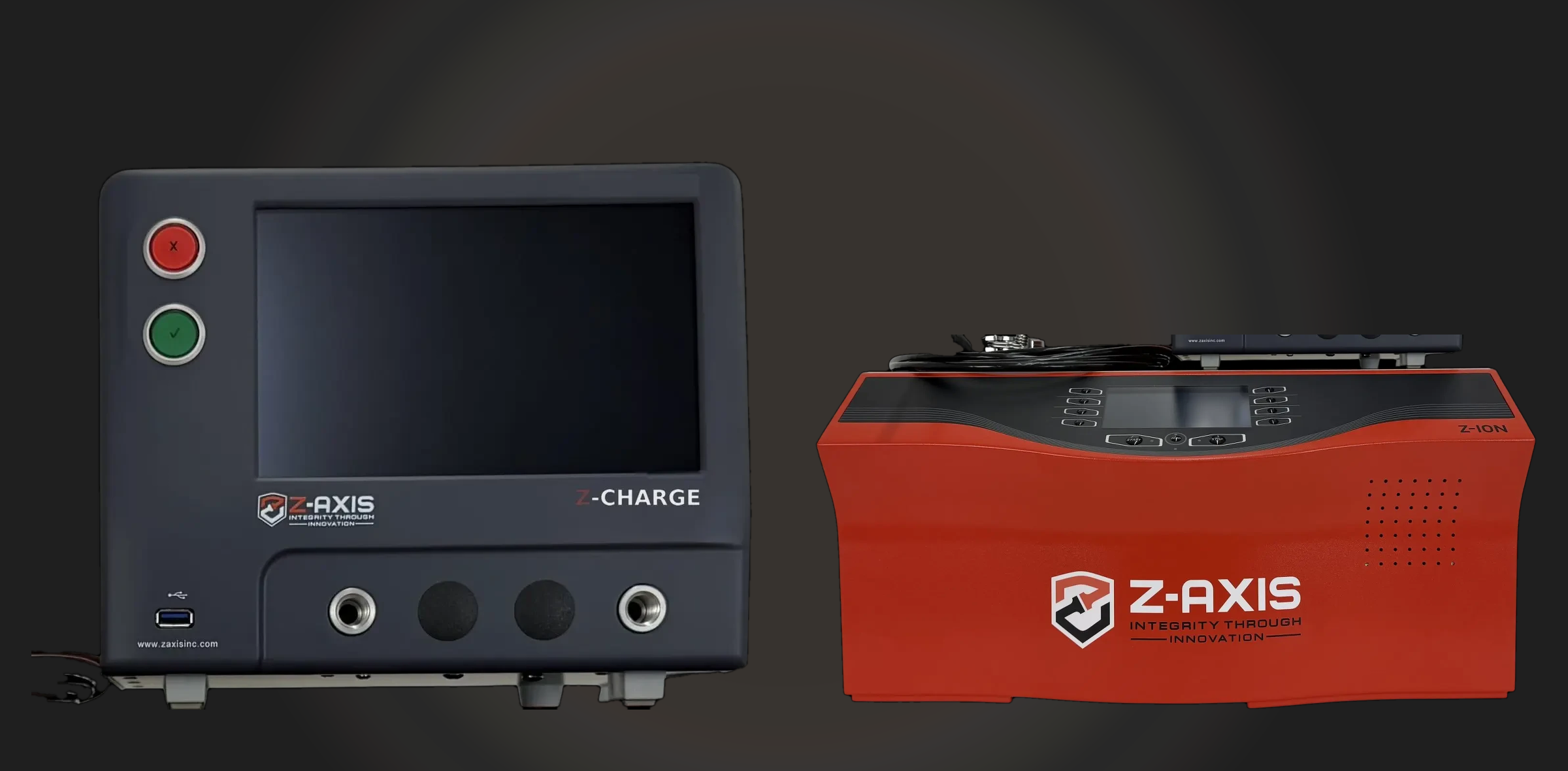 Z-Charge + Z-IonA coordinated controller and helium mass-spectrometer detector for helium test sequences.
 Z8An 8-inch modular platform for programmed leak-test sequences and recorded results.



