
Target leak rate ≥ 0.1 sccm
Air pressure decay or mass flow
Z8 / Z5 / Z1 — pick by test volume and cycle time

Leak Testing Basics
A leak test determines whether an object, product or system stays within a specified leak range.
Air leak testers apply pressure and measure the pressure change because leaks move from higher pressure to lower pressure.
Holes, cracks and weak seals can affect final-product performance, so production tests compare the results against an acceptable leak rate.
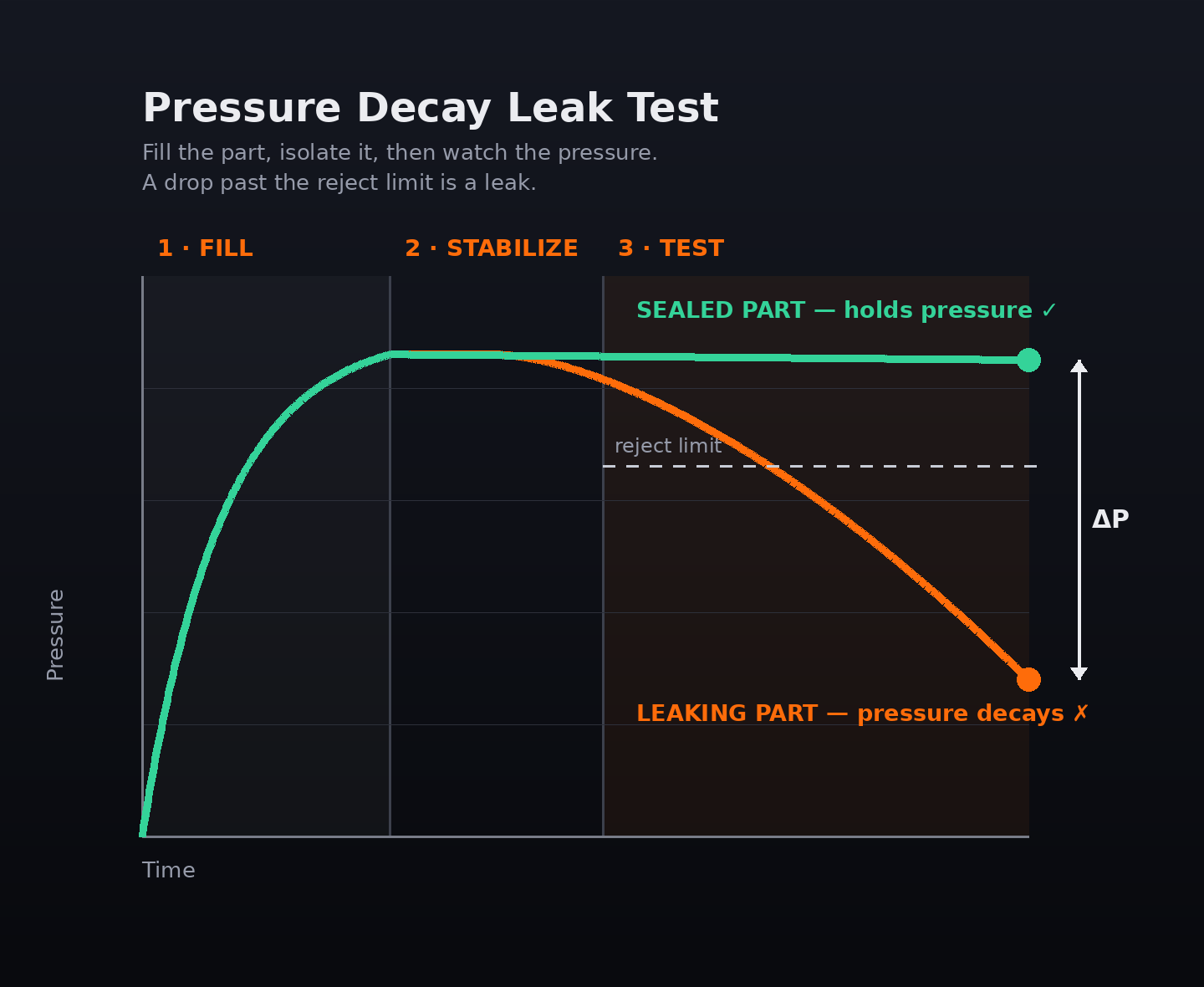
Request for QuoteThe test connects the part to a tester, establishes the test pressure and measures the pressure or flow response during the test time. A typical production cycle runs as a repeatable fill, settle, test and vent sequence: the part is pressurized or evacuated, the air is allowed to stabilize, the tester measures for the programmed test time, and the part is vented before it is unloaded.
Pressure decay, vacuum decay, mass flow, chamber and trace-gas methods use different measurements for different parts and access conditions. The result is compared with the allowed leak rate for the part, and the tester reports pass or fail.
Leak rate is expressed as volume per unit of time. The calculation uses the change in pressure multiplied by the test volume, then divides by the change in time multiplied by atmospheric pressure.
Leak rate (SCCM) = (Δp ÷ Δt) × (V ÷ ATM)
ATM means atmospheric pressure in PSIA; V is test volume in cm3; Δp is pressure decay during test time; Δt is decay time in minutes (the calculator accepts seconds and converts); SCCM means Standard Cubic Centimeters per Minute.
Using the example values, leak rate = .02psi/0.05min × 50cm3/14.7psia. The result is 1.36 SCCM.
Air leak detection is an essential manufacturing step. Destructive and non-destructive air leak tests help manufacturing lines and OEMs meet specifications and regulations. The right test depends on the product and its application.
Only a chamber test can run on an enclosed object, while an object with a single opening may use several other tests. Common methods include Pressure Decay (PD), Vacuum Decay (VD), Occlusion (Occ), Mass Flow (F), Burst (B), Crack (C) and Chamber (PR).
Pressure decay is a widely used non-destructive method for small sealed components with one access port; a decrease in pressure over time indicates a leak. Vacuum decay is its inverse: a rise in pressure indicates a leak. Occlusion measures air movement and determines whether a passage is blocked.
Burst testing measures maximum pressure at catastrophic failure. Pressure cracking is similar but more sensitive and often detects a valve opening. Chamber testing finds leaks in sealed electronics or packaging without an access port and can suit products that must meet IP67 standards.
Target leak rate ≥ 0.1 sccm
Air pressure decay or mass flow
Z8 / Z5 / Z1 — pick by test volume and cycle time
Target leak rate < 0.1 sccm
Helium / trace gas
Z-Charge + Z-Ion Helium Test Cell — hard vacuum for the very tightest specs
| Method | Works down to | Zaxis product |
|---|---|---|
| Air pressure decay | ~0.1 sccm (0.01 with tight control) | Z8, Z5, Z1 |
| Air mass flow | ~0.1 sccm, larger volumes | Z-series, sized to application |
| Helium / trace gas | ~1e-5 sccm | Z-Charge + Z-Ion |
| Helium hard vacuum | 1e-6 sccm and below | Ask an engineer (RFQ) |
0.001 sccm (1e-3) is not production-realistic with air pressure decay.
Why volume matters: in pressure decay the pressure change from a leak scales inversely with test volume — smaller volume, longer dwell and stable temperature reach lower leak rates.
Use the leak-rate calculator to work through SCCM for your part, or Request a Quote to discuss test volume, cycle time and the acceptance limit with a Zaxis engineer.
When standard methods are not enough, high-precision specialty air leak tests can support product viability. Combined with a standard test, specialty methods provide quality assurance during product development and manufacturing.
Specialty tests include Backpressure Flow, Pressure Increase, Valve Reseat, Creep/Ramping, Fill Pressure Exercise and Vacuum Exercise. Additional detection methods include Bubble/Submersion, Hard Vacuum (Helium), Helium Accumulation, Sniff or Spray, Tracer Gas and Ultrasonic.
For help identifying leak-rate metrics or selecting a non-destructive method for a manufacturing line, call 801-872-7292. The Zaxis team can help calculate SCCM for a leak detection application.
The selection process considers product access, test sensitivity, production requirements and the leak-rate limit used for acceptance.
A chamber test can evaluate an enclosed object that has no access port.
PD means Pressure Decay, a non-destructive method for a sealed component with an access port.
In vacuum decay testing, a rise in pressure indicates a leak.
Backpressure Flow, Pressure Increase, Valve Reseat, Creep/Ramping, Fill Pressure Exercise and Vacuum Exercise are specialty options.
Chamber testing can suit sealed products that need to meet IP67 standards.
The Zaxis team can help identify the pressure, volume and time metrics used to calculate SCCM.


