
FILL
Charge the part with helium or hydrogen forming gas to the programmed test pressure.

Helium Leak Test Method
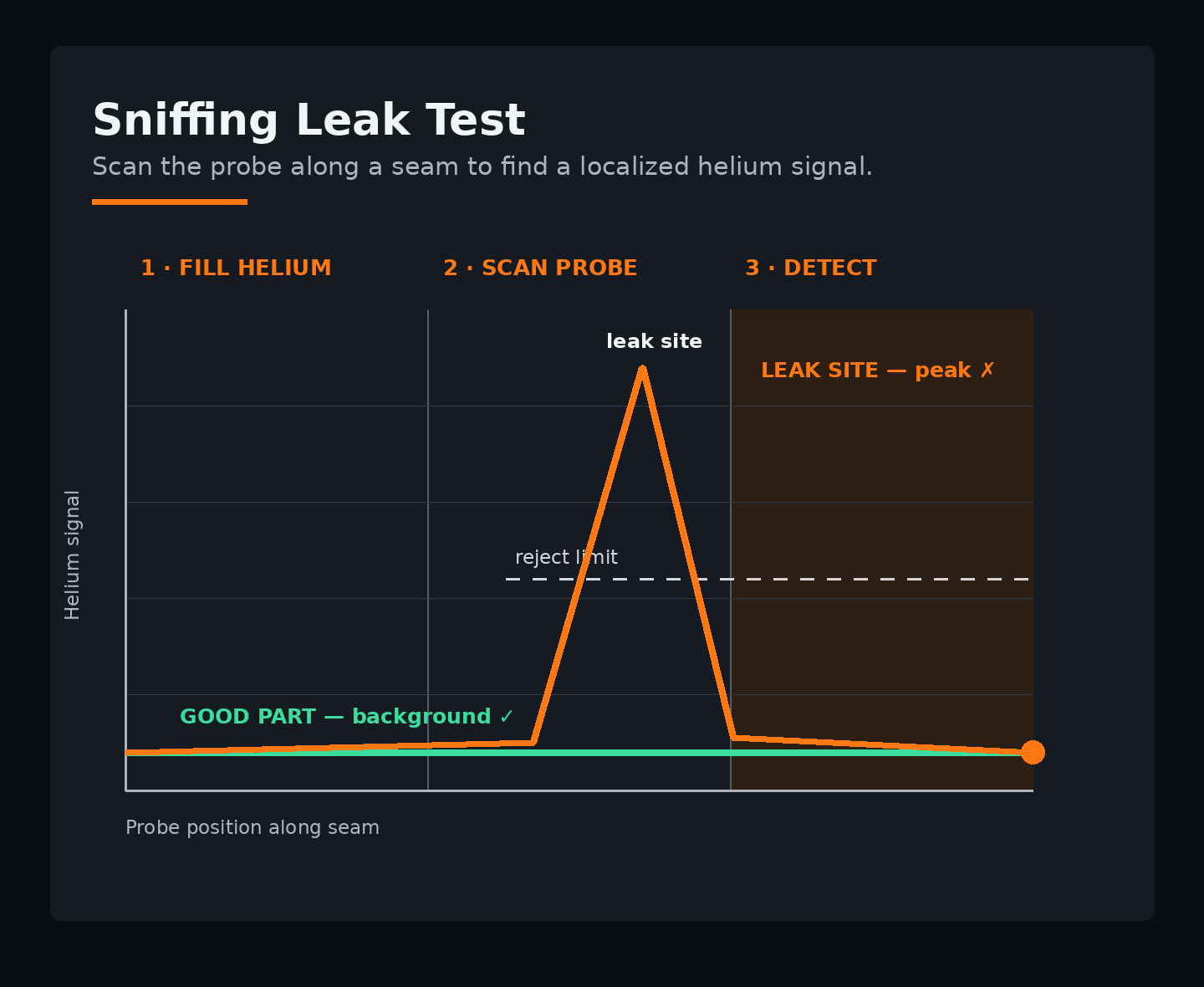
Sniffing leak testing charges a part with trace gas and scans its seams with a probe, producing a signal peak at the physical leak site.
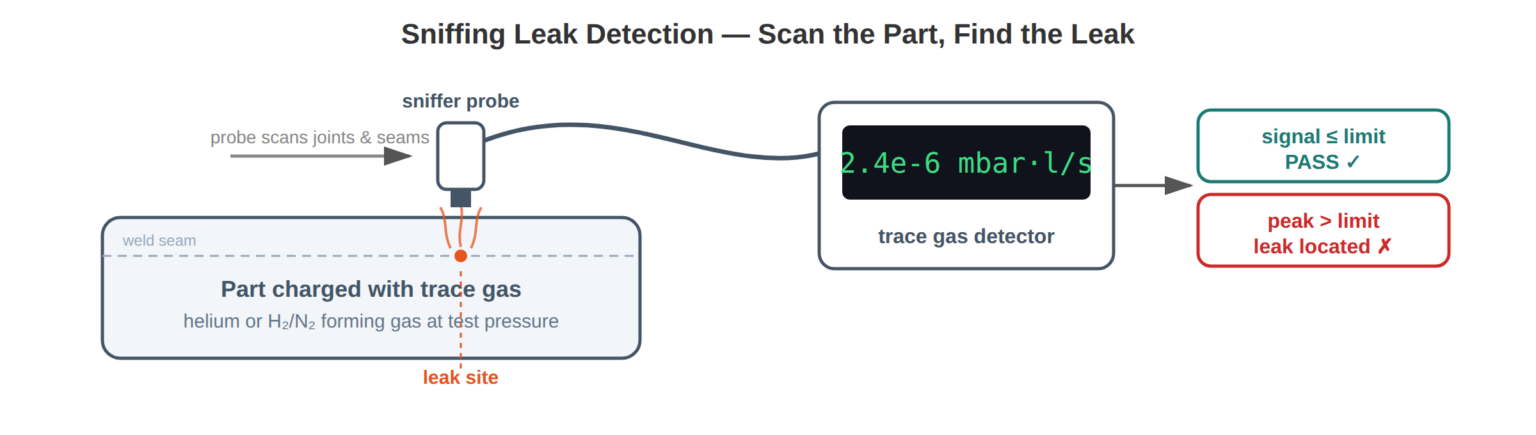
Sniffing, or sniffer leak detection, is a trace-gas method for finding where a part leaks. The part is charged with helium or 5%/95% hydrogen forming gas, then a probe follows welds, joints, seals and fittings.
The probe continuously samples the surrounding air. Over a leak, escaping trace gas enters the probe and creates a signal peak that identifies the site and indicates its approximate leak rate.
Sniffing routinely finds leaks in the 10⁻⁵ to 10⁻⁷ mbar·l/s range without a vacuum chamber or immersion. It complements whole-part methods that measure total leakage.
Request for QuoteSniffing turns a trace-gas result into a physical location. The detector samples air close to likely leak features instead of measuring pressure change in the part.
An operator or programmed motion follows welds, joints, seals and fittings. Background stays low away from a leak and rises locally where charged gas escapes.
This method needs neither a vacuum chamber nor immersion. It provides direct investigation of a rejected assembly and an approximate leak-rate indication at the site, typically in the 10⁻⁵ to 10⁻⁷ mbar·l/s range.
The probe turns a leak result into a location. An operator or programmed motion follows likely leak features, including welds, joints, seals and fittings. Background stays low away from a leak and rises locally where trace gas escapes.
Sniffing uses neither a vacuum chamber nor immersion. After the part is charged with the selected trace gas, the detector samples air near suspected leak paths. This supports direct investigation of a rejected assembly and an approximate leak-rate indication at the site.
Recorded sniffing results can be used with whole-part testing: the whole-part method establishes total leak behavior, while the probe identifies the area for rework evaluation.
Charge the part with helium or hydrogen forming gas to the programmed test pressure.
Move the sniffer probe along welds, joints, seals and fittings.
The probe samples surrounding air and the detector reports a signal where trace gas escapes.
Complete the scan and vent or recover the test gas under the programmed sequence.
A signal within the programmed reject limit passes; a signal above the limit identifies a leak location for evaluation.
Sniffing measures trace gas at the probe rather than pressure change in the part. A signal peak occurs when the probe passes over escaping gas.
The scan path covers welds, joints, seals and fittings, and detector response identifies the local area for rework or investigation.
Helium and forming gas are trace-gas options. The sequence prepares and charges the part before scanning, then records the detector result.
A consistent scan path makes results more comparable from part to part.
The detector samples air close to suspected leak paths after the part is charged with the selected trace gas.
A whole-part test can establish total leakage while sniffing identifies the area for rework evaluation.
The scan can follow the same defined features on every part, giving operators a consistent trace-gas path.
The recorded scan supports a clear follow-up decision for the assembly.
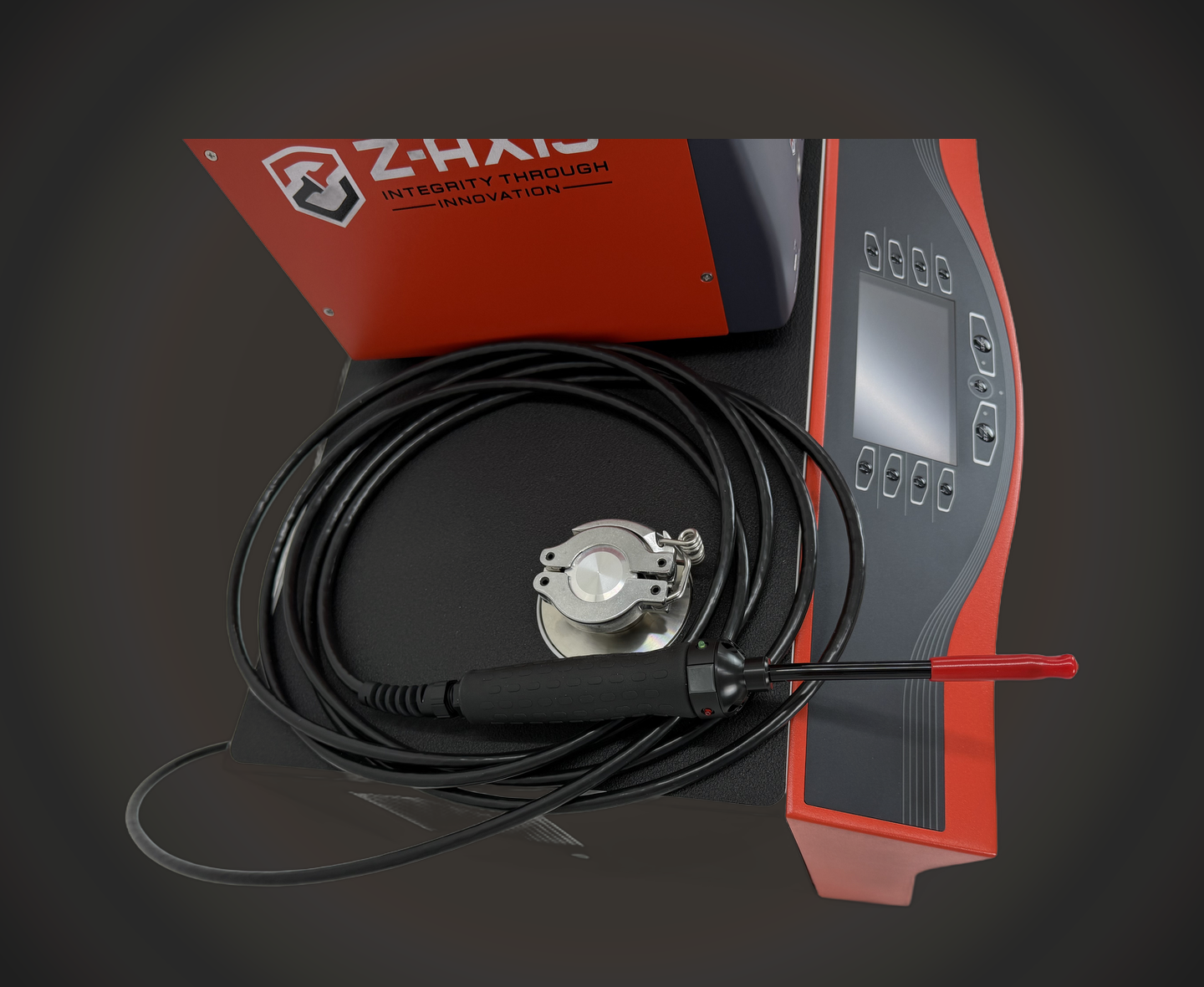
Sniffing needs a helium-charged part and a probe-fed detector. Z-Charge charges the part; Z-Ion reads the probe signal and flags the leak site.

Charged assemblies can be scanned at joints and fittings to locate a leak.
Sealed battery-related components can be scanned where a physical leak location is needed.
Charged medical components can be scanned along seals and joints for rework evaluation.
| Method | Non-destructive | Needs an access port | Locates the leak | Typical use |
|---|---|---|---|---|
| Pressure decay | ✓ | ✓ | × | Sealed parts with a port |
| Vacuum decay | ✓ | ✓ | × | Parts and packaging |
| Mass flow | ✓ | ✓ | × | Flow-rate limits |
| Occlusion | ✓ | ✓ | × | Blocked passages |
| Burst | × | ✓ | × | Failure pressure |
| Pressure cracking | ✓ | ✓ | × | Valve opening pressure |
| Chamber | ✓ | × | × | Sealed parts, no port |
| Sniffing | ✓ | ✓ | ✓ | Finding the leak site |
| Hard vacuum | ✓ | ✓ | × | Hermetic, safety-critical parts |
| Accumulation | ✓ | ✓ | × | Large parts, total leak rate |
| Bombing | ✓ | × | × | Sealed parts, no fill port |
| Differential pressure | ✓ | ✓ | × | Large volumes, low leak rates |
| Trace gas | ✓ | ✓ | ✓ | Very small leaks, quantified |
It charges a part with trace gas and scans welds, joints, seals and fittings with a probe that samples surrounding air.
It detects escaping helium or hydrogen forming gas and produces a signal peak at the leak site.
Yes. It is the trace-gas method used to pinpoint the physical leak site.
It routinely finds leaks in the 10⁻⁵ to 10⁻⁷ mbar·l/s range.
No. It is performed without a vacuum chamber or immersion.
Helium or 5%/95% hydrogen forming gas can charge the part before scanning.
Hard vacuum measures a whole-part total leak rate, while sniffing identifies where a leak is located.

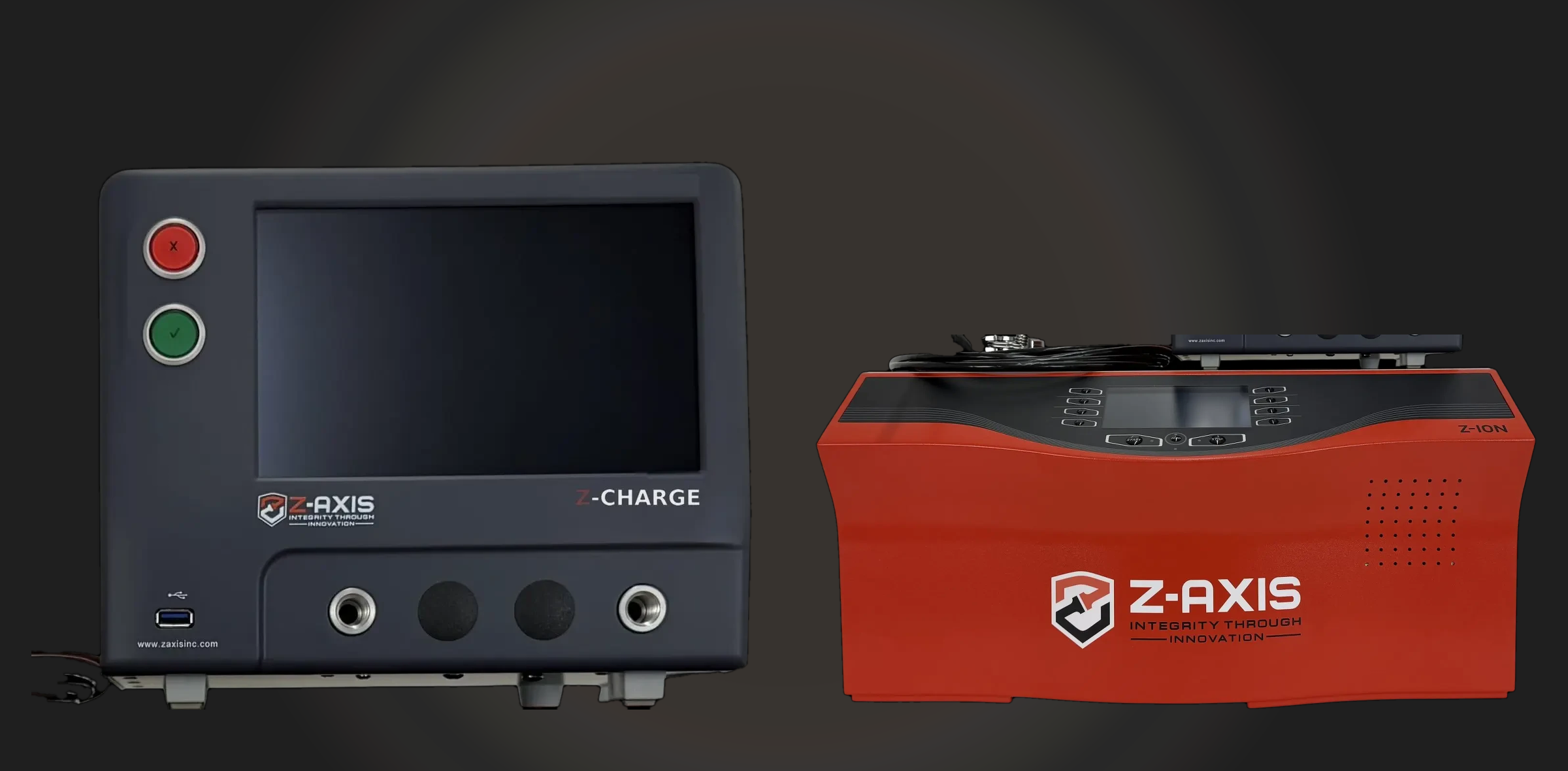 Z-Charge + Z-IonA coordinated controller and helium mass-spectrometer detector for helium test sequences.
 Z8An 8-inch modular platform for programmed leak-test sequences and recorded results.



