
Optimizing Pressure Decay Leak Tests
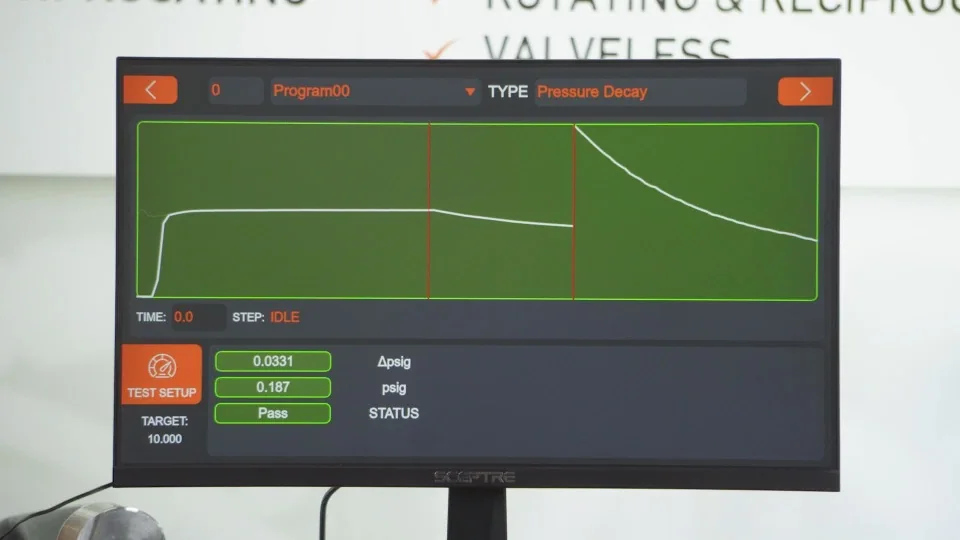
Setting up a reliable leak test is one thing, but optimizing it for real-world production is another. In this blog, we break down the key lessons from our training video series on pressure decay leak testing. You’ll learn how to interpret results, adjust key parameters, and ensure your test reliably separates good parts from bad ones. Whether you’re an engineer, quality manager, or process technician, this guide will help you improve accuracy and build a more stable test.
What is Pressure Decay Leak Testing?
Pressure decay leak testing is a non-destructive method that measures how much pressure is lost from a sealed part over time. If the part leaks, pressure decays faster. If it’s sealed, the decay levels off.
This method is widely used across industries because it’s:
- Fast
- Accurate
- Repeatable
Setting Up Your Test Using a Master Part & Leak Standard
Every good leak test begins with two key tools:
The Master (Golden) PartThis is a known-good part used to establish your baseline decay. It shows what “normal” looks like in a perfect scenario.
The Leak StandardA leak standard is a calibrated device that simulates the exact leak rate defined in your engineering spec.
For example:
- If a part needs to be waterproof to IP67, the air-leak equivalent might be around 2 cc/min.
- Below this threshold, water won’t escape.
- Above it, the part fails the waterproofing requirement.
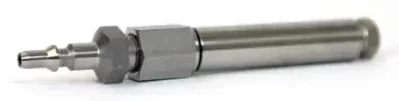
By testing your master part with and without the leak standard attached, you determine whether your test provides enough separation to confidently detect a failure.
Understanding Pass/Fail Thresholds
A common rule of thumb is the 3:1 separation rule: Your leaking part should show roughly three times more decay than your good part.
If the master part produces 0.03 decay, a failing part should ideally be around 0.09. If you’re not seeing that kind of separation, your test needs tuning.
Environmental & Human Influences You Must Control
Leak testing is sensitive. The following factors can shift results:
- Ambient temperature changes
- HVAC systems turning on/off
- Building airflow
- Operator body heat
- Part temperature from previous tests
- Material compliance (soft parts expanding like a balloon)
Even placing a hand on the part can change the decay curve due to heat transfer. A good test minimizes the impact of these external variables.
The Iterative Tuning Process: Fill Time + Test Step Time
This is the core of optimizing your leak test.
Adjusting Fill Time
Increasing fill time helps:
- Stabilize temperature
- Reduce thermodynamic effects
- Allow the part to reach equilibrium
- Tighten the natural variance of your results
This makes your master part more repeatable and predictable.
Adjusting Test Step Time
Once the fill step is stable, increasing the test time helps widen the gap between good and bad parts.
- Good part: decay levels off
- Leaking part: decay continues downward
The longer the test time (within reason), the more those curves separate. This is the key to achieving the 3:1 separation rule.
Why You Shouldn’t Test Just One Sample Part
Repeatedly testing the same physical part can cause compliance, especially in soft materials.
It’s similar to blowing up a balloon:
- The first time is difficult.
- After that, the balloon expands more easily.
Leak-tested parts behave the same way. To avoid misleading results:
- Use multiple test samples (ideally 10+)
- Rotate through them during optimization
- Allow parts to rest 2 minutes or more between runs
This simulates true production conditions and prevents artificially “good” results.

Choosing Between Pressure and Vacuum Decay
Both methods measure leaks, but the direction of force can change how the part behaves.
Positive Pressure- Air is pushed into the part
- Useful for detecting seam failures
- Can expose weak bonds or gaps
- Air is pulled out of the part
- Can sometimes mask leaks by collapsing or seating internal seals
- Better for some geometries, but not all
Choosing the right test depends on:
- Part design
- Material behavior
- Joint construction
- How the part is used in real life
Your goal is to choose the method that reveals, not hides, leaks.
Real-World Applications
Pressure decay leak testing is used across various industries, including:
- Medical devices
- Electronics housings
- Automotive components
- Fluid-handling parts
- Consumer products
- HVAC and appliance components
- Custom-manufactured enclosures and assemblies
If a part needs to hold pressure or keep the outside world out, this testing method applies.
Ready to Improve Your Leak Testing?
Setting up an effective pressure decay leak test is a thoughtful, iterative process: one that depends on understanding your part, controlling environmental influences, and fine-tuning test parameters until good and bad parts are clearly distinguishable. By establishing a reliable master part, using a calibrated leak standard, and adjusting fill and test times to create strong separation between results, manufacturers can build a test that performs consistently at production speeds. If you’re ready to optimize your leak testing process or have questions about your specific application, contact our team today: we’re here to help you get the most out of your testing setup.
Related posts
Talk with a leak testing specialist
Discuss the right test approach for your part and production requirements.
Request a Quote