
FILL
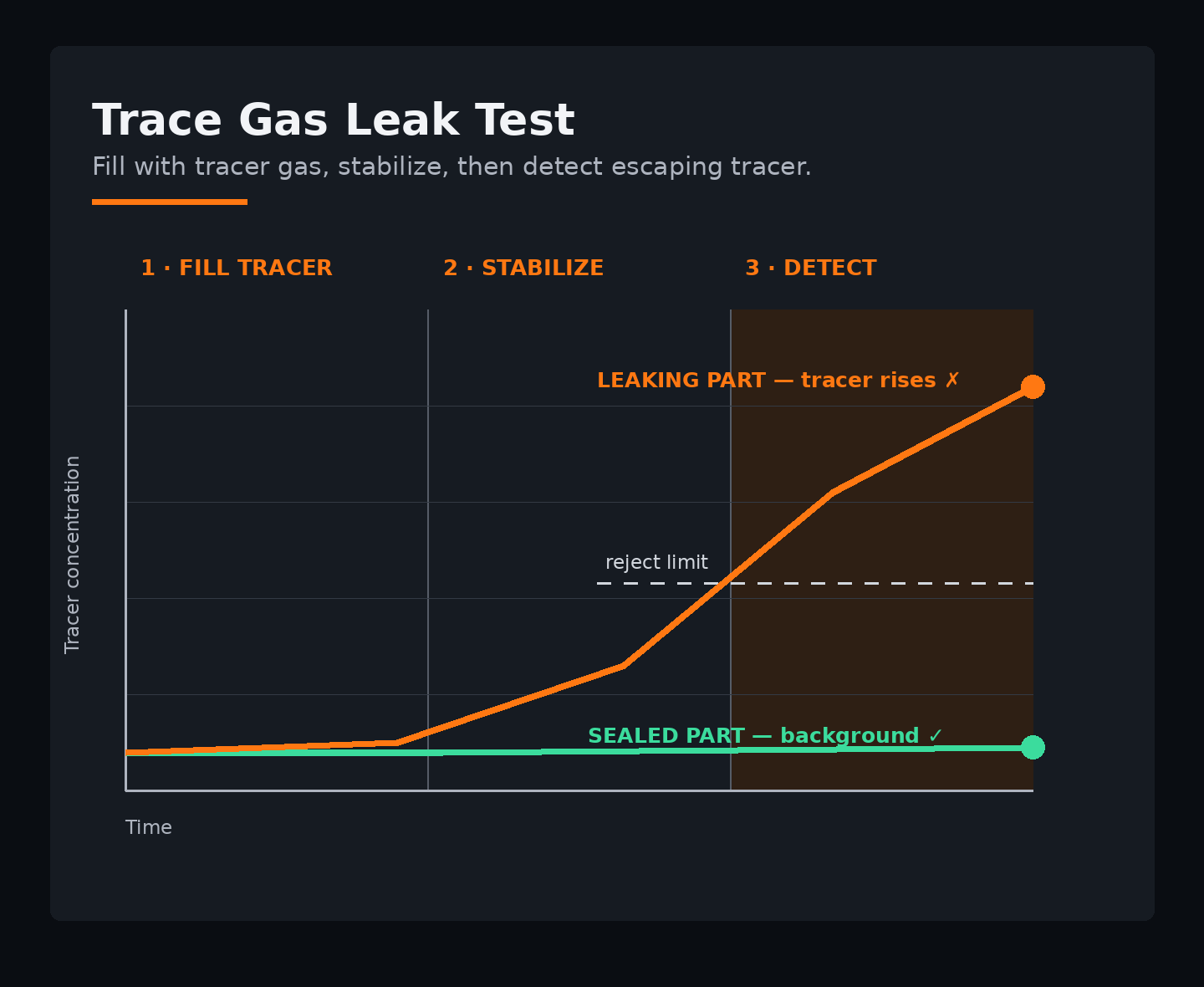
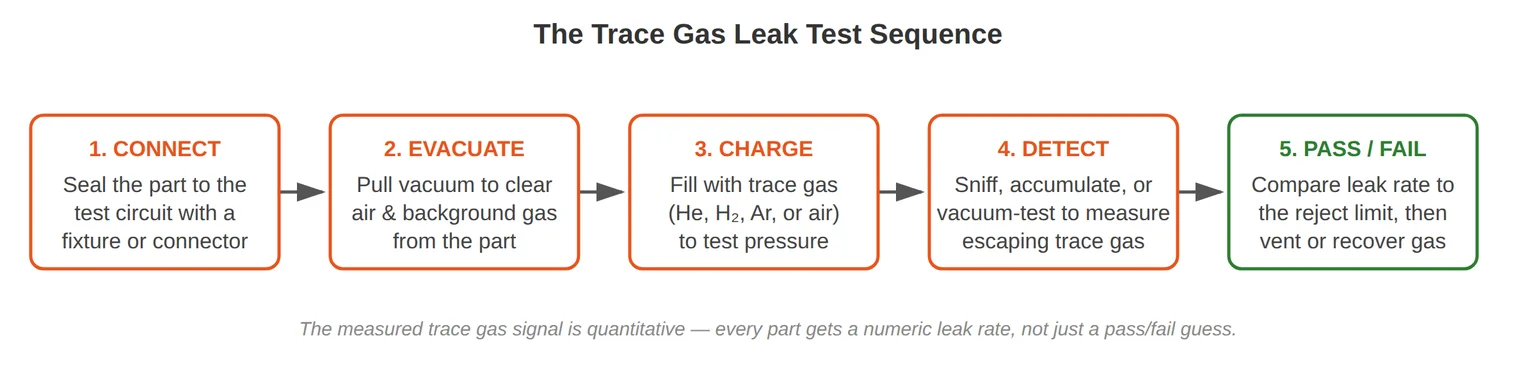
Fill the sealed part with the selected trace gas at the programmed condition.

Helium Leak Test Method
Trace gas leak testing fills a sealed part with an identifiable gas and measures the molecules that escape, producing a sensitive quantitative leak result.
Trace-gas leak testing fills a sealed part with a gas the detector can identify, then measures the gas that escapes. Helium, hydrogen forming gas, argon and clean dry air are options.
Because the instrument detects escaping molecules instead of inferring a leak from pressure change, trace-gas methods can find smaller leaks, locate a leak site and produce a quantitative, recordable leak rate.
Helium hard vacuum systems resolve 10⁻⁹ to 10⁻¹¹ mbar·l/s, and helium sniffing typically reaches about 10⁻⁷ mbar·l/s. Forming-gas sniff detection typically reaches about 10⁻⁷ mbar·l/s, argon-capable detectors roughly 10⁻⁶ mbar·l/s, and air-based detection roughly 10⁻⁴ mbar·l/s.
Request for QuoteTrace-gas testing detects the selected gas outside a sealed part, not a pressure change over time. The detector and method determine whether the result measures total leakage, locates a leak or does both.
Helium is inert and non-flammable with low background. Forming gas is 5% hydrogen in 95% nitrogen for sniff detection, while argon and clean dry air are additional choices with compatible detection.
The method determines the result: sniffing follows seams and fittings to locate a leak; hard vacuum measures total leakage at maximum sensitivity; accumulation measures gas collected around a part; and bombing evaluates finished sealed devices without a direct connection.
A trace-gas result comes from detecting the selected gas outside the part, rather than measuring pressure change over time. The detector and method determine whether the result measures total leakage, locates a leak or does both.
Helium is an inert, non-flammable tracer with low background. Forming gas is 5% hydrogen in 95% nitrogen for sniff detection; argon and clean dry air are additional options with compatible detection. The choice follows the required sensitivity and method.
Trace-gas methods support different measurements: sniffing follows seams and fittings to find a leak; hard vacuum measures total leakage at maximum sensitivity; accumulation measures gas collected around a part; and bombing evaluates finished sealed devices without a direct connection.
Fill the sealed part with the selected trace gas at the programmed condition.
Allow the part and test setup to reach the required measurement condition.
Measure escaping trace gas with the selected detection method.
Record the quantitative leak result and compare it with the programmed reject limit.
A result within the programmed reject limit passes; a result above the limit fails.
Trace-gas detectors respond to the escaping gas itself, reducing the influence of temperature drift, part flexing and volume effects seen in pressure-decay testing.
Gas choice follows required sensitivity and operating constraints. Helium has low atmospheric background; forming gas is 5% hydrogen in 95% nitrogen; argon is an alternative; and compatible instruments can use clean dry air.
The method may be sniffing for location, hard vacuum for maximum sensitivity, accumulation for a total result in a chamber, or bombing for finished sealed parts without a direct connection.
The detector responds to the selected gas outside the part, not a pressure change inside it.
Select the gas and method together based on required sensitivity and compatible detection.
The method determines whether the result locates a leak, measures total leakage or provides both.
A programmed sequence keeps fill, stabilization, detection and result recording tied to the same part and selected method.
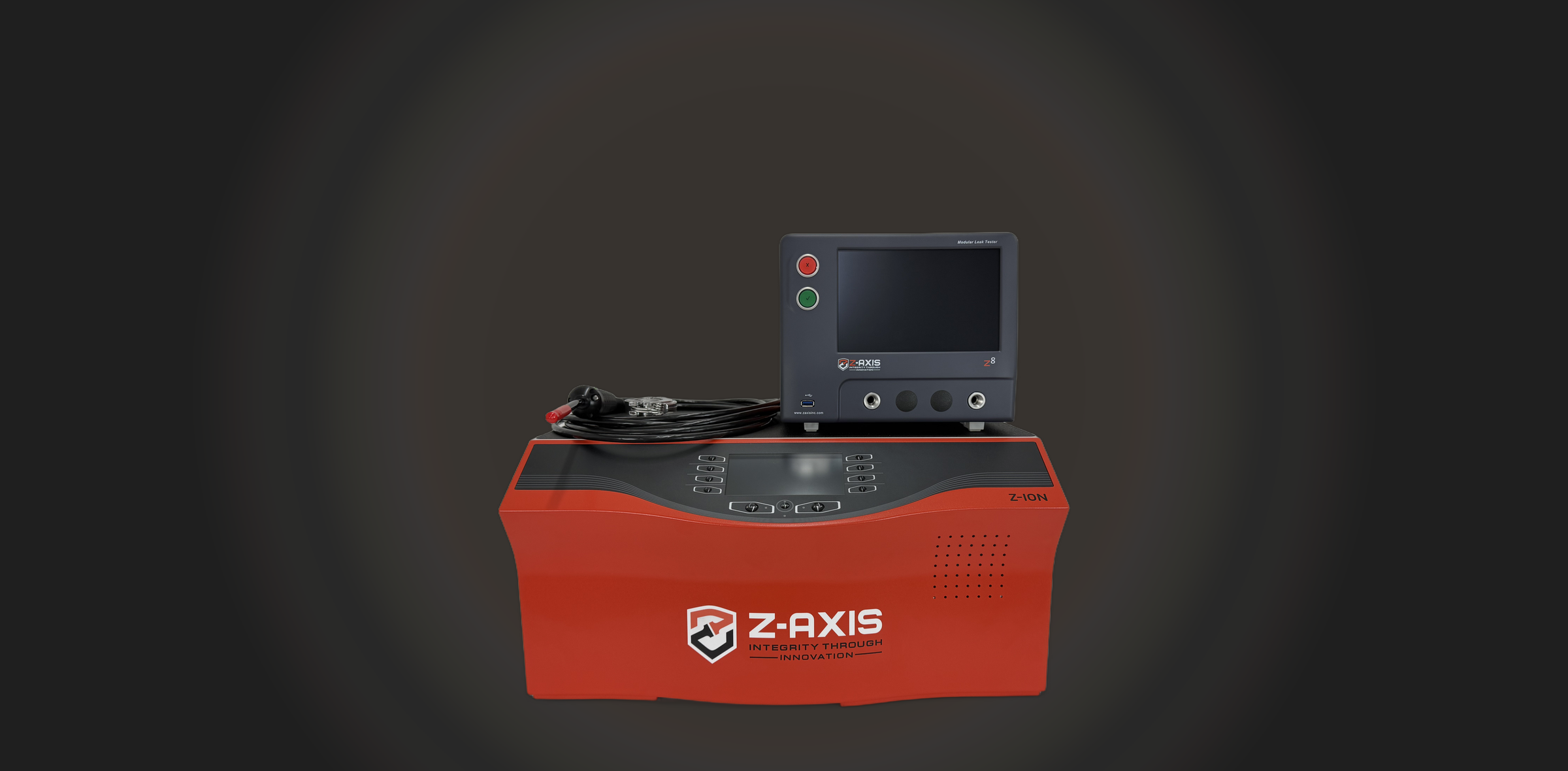
Trace-gas testing pairs a charging system with a gas-specific detector. Z-Charge evacuates, purges and charges the part; Z-Ion detects the escaping helium.

Trace-gas methods support sensitive, quantitative testing of sealed medical components.
Hermetic packages, sealed wearables and assemblies can use trace-gas detection.
Battery enclosures and thermal-management components can be evaluated with the selected trace-gas method.
| Method | Non-destructive | Needs an access port | Locates the leak | Typical use |
|---|---|---|---|---|
| Pressure decay | ✓ | ✓ | × | Sealed parts with a port |
| Vacuum decay | ✓ | ✓ | × | Parts and packaging |
| Mass flow | ✓ | ✓ | × | Flow-rate limits |
| Occlusion | ✓ | ✓ | × | Blocked passages |
| Burst | × | ✓ | × | Failure pressure |
| Pressure cracking | ✓ | ✓ | × | Valve opening pressure |
| Chamber | ✓ | × | × | Sealed parts, no port |
| Sniffing | ✓ | ✓ | ✓ | Finding the leak site |
| Hard vacuum | ✓ | ✓ | × | Hermetic, safety-critical parts |
| Accumulation | ✓ | ✓ | × | Large parts, total leak rate |
| Bombing | ✓ | × | × | Sealed parts, no fill port |
| Differential pressure | ✓ | ✓ | × | Large volumes, low leak rates |
| Trace gas | ✓ | ✓ | ✓ | Very small leaks, quantified |
It fills a sealed part with an identifiable gas and measures the gas that escapes.
Helium, hydrogen forming gas, argon and clean dry air can be used as trace gases.
Helium is inert, non-toxic and non-flammable, with low atmospheric background and a small molecule.
Forming gas is 5% hydrogen in 95% nitrogen and can be used for high-throughput sniff detection.
Yes. Sniffing measures escaping trace gas along seams, joints and fittings to identify the leak site.
Helium hard vacuum testing resolves 10⁻⁹ to 10⁻¹¹ mbar·l/s.
Compatible instruments can use clean, dry compressed air and reach roughly 10⁻⁴ mbar·l/s.

Trace gas is a peer to air-based methods. Compare the options in the leak test method chooser and read the pressure-decay buyer’s guide for the air-based route.
For HVAC and refrigeration components, see HVAC & Refrigeration Leak Testing for peer air and trace-gas production method routing.
Trace gas is a peer to air-based methods. Compare the options in the leak test method chooser and read the pressure-decay buyer’s guide for the air-based route.
Plan the test boundary with the Leak Test Fixture Design Guide and review IP67 / IP68 production leak testing for ingress-driven enclosure programs.
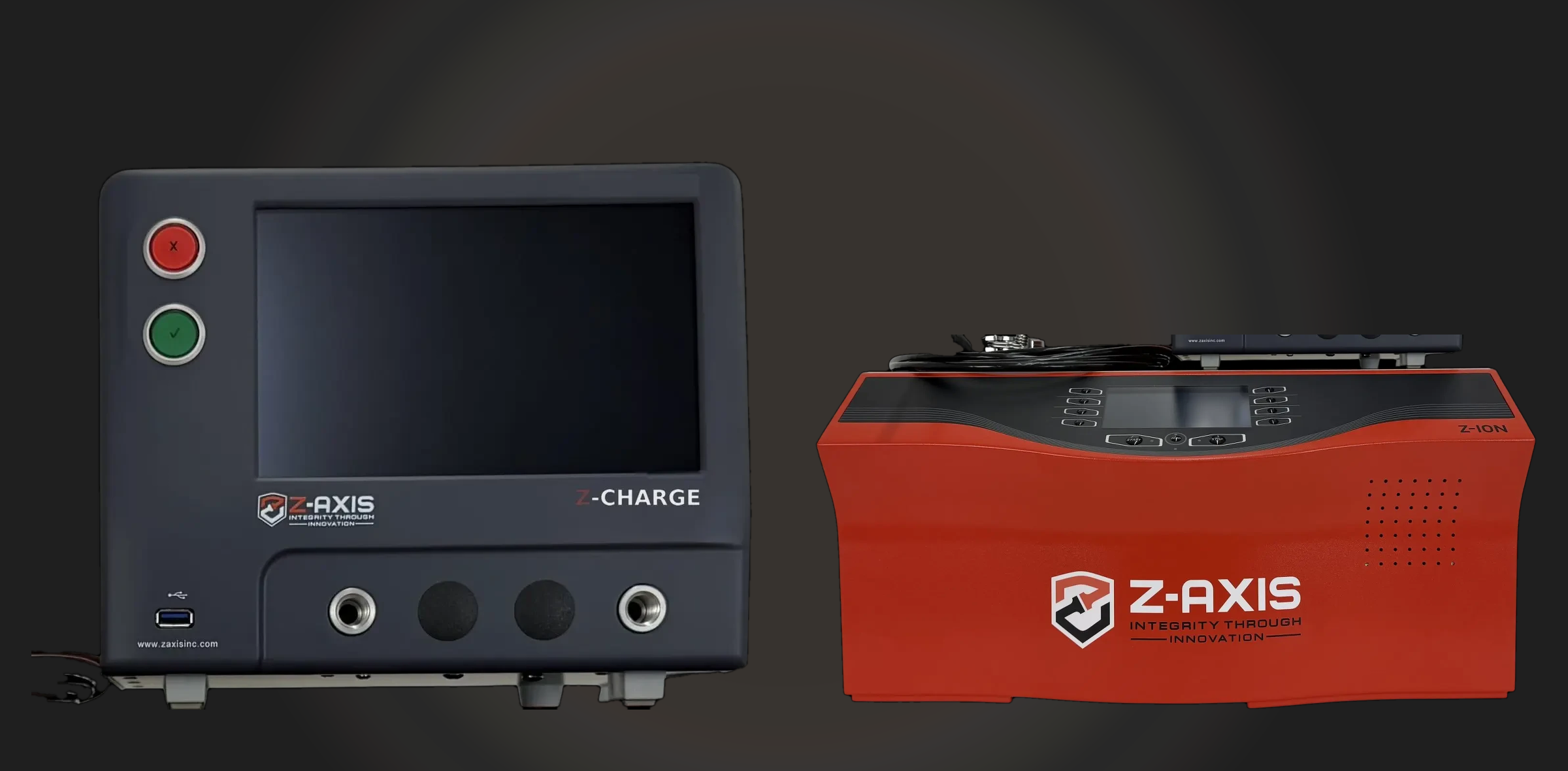 Z-Charge + Z-IonA coordinated controller and helium mass-spectrometer detector for helium test sequences.
 Z8An 8-inch modular platform for programmed leak-test sequences and recorded results.



